Support our educational content for free when you purchase through links on our site. Learn more
7 Common Tea Plant Diseases and How to Control Them 🌿


Common tea plant diseases and their control starts with three things: identify the affected plant part, improve the growing conditions that encourage disease, and confirm the cause before treating. Good drainage, clean pruning tools, and regular checks can prevent small problems from turning into a struggling tea bush.
We’ve learned not to trust the first clue too much. A yellowing tea plant may have root disease—or simply sogy soil—while blistered young leaves point toward a very different problem. That’s why our first inspection moves from leaf to stem to soil, instead of straight to the spray bottle.
Key Takeaways
- Check symptoms and growing conditions before choosing a treatment. Leaf spots, cankers, and root decline have different causes and controls.
- Prevent disease with good drainage, airflow, clean tools, and prompt removal of infected debris.
- Blister blight, grey blight, algal leaf spot, root rots, and stem cankers are among the tea problems growers may encounter.
- Root diseases can be difficult to manage once established. Diagnose early, remove severely affected plants when advised, and get local guidance before replanting.
- Use fungicides only when appropriate and legally labeled for tea in your region. Never copy a product recommendation without checking local rules.
- When symptoms are spreading or unclear, ask an extension service or plant diagnostic lab. A reliable diagnosis saves guesswork—and often saves plants.
Table of Contents
- ⚡️ Quick Tips and Facts
- 🌱 Tea Plant Disease Basics: Causes, Conditions, and Risk Factors
- Why tea plants are vulnerable to disease
- How weather, soil, and garden practices affect disease risk
- 🔍 Tea Disease Symptoms: How to Spot Trouble Early
- Leaf spots, blisters, wilting, and dieback
- Root and stem symptoms that need attention
- Disease or nutrient deficiency? How to tell the difference
- 🧪 Identifying Tea Plant Diseases and Getting a Diagnosis
- When to consult a plant pathologist or extension service
- How to collect and submit a tea plant sample
- 🍂 Common Leaf Diseases of Tea
- 1. Blister blight
- 2. Grey blight
- 3. Brown blight and leaf spot
- 4. Red rust and algal leaf spot
- 5. Other fungal leaf spots and shoot diseases
- 🌿 Root Diseases of Tea: Identification and Control
- 1. Black root rot
- 2. Red root rot
- 3. Violet root rot
- 4. Other root rots and root-knot problems
- How to control tea root diseases
- 🪵 Stem and Trunk Diseases of Tea
- 1. Collar canker
- 2. Wood rot and heart rot
- 3. Dieback, cankers, and branch infections
- How to manage tea stem diseases
- 🛡️ Integrated Disease Management for Tea Plants
- Prevention through site selection and soil care
- Pruning, sanitation, and infected-plant removal
- Resistant varieties and healthy planting material
- Biological controls and beneficial soil microbes
- Fungicides: safe, legal, and targeted use
- A seasonal tea garden disease-prevention checklist
- 🚫 Common Tea Disease-Control Mistakes to Avoid
- 🌦️ Tea Disease Management by Climate and Growing Setup
- Humid and rainy regions
- Home gardens, containers, and greenhouses
- ✅ Conclusion
- 🔗 Recommended Links
- ❓ FAQ
- Can tea plants recover from root rot?
- Should I remove leaves affected by blister blight?
- Can tea plant diseases spread to other garden plants?
- Are homemade fungicides effective against tea diseases?
- How often should I inspect tea plants for disease?
- 📚 Reference Links
Quick Tips and Facts
- Start with the plant part that looks unhealthy. Leaf spots, shoot dieback, and whole-plant wilting point to different problems; they are clues, not a diagnosis. For a broader overview, see our guide to common pests and diseases that affect tea plants.
- Drainage is a first-line defense. Tea likes consistently moist, acidic soil, but roots that sit in water are more vulnerable to root diseases. The University of Hawaiʻi Cooperative Extension emphasizes suitable site and soil conditions for healthy tea cultivation.
- Keep foliage airy and avoid prolonged leaf wetness. Give plants room, prune for airflow, and water the soil rather than repeatedly weting leaves. These practices can reduce conditions favorable to several foliar diseases, including blister blight and algal leaf spot. (Penn State PlantVillage)
- Treat root rot as a prevention problem. Once a serious root disease is established, recovery can be difficult. Remove severely affected plants and roots where appropriate, and get a reliable diagnosis before replanting.
- Clean tools between diseased cuts. Pruning shears can move infected material from one branch or plant to another. Wipe or disinfect blades between cuts, especially when removing cankered tissue. (Penn State PlantVillage)
- Don’t spray by guesswork. The right treatment depends on the disease, local regulations, and whether the product is labeled for tea. Follow the label and local agricultural guidance; recommendations from one tea-growing region may not be legal or suitable in another.
- Not every tea-plant problem is a disease. Mites, scale insects, nutrient imbalance, drought, and waterlogging can mimic disease symptoms. The UPASI Tea Research Foundation’s pest and disease resource is especially useful for separating pest damage from infection.
Quick field check: Note which plant parts are affected, whether symptoms are spreading, recent rainfall or irrigation, and whether the soil is waterlogged. Then inspect the underside of leaves and the plant’s collar—the stem base where it meets the soil. That last spot can tell us more than a dramatic-looking leaf ever will.
Tea Plant Disease Basics: Causes, Conditions, and Risk Factors
Tea (Camellia sinensis) is a long-lived evergreen shrub grown for repeated harvests of tender shoots. In commercial fields, large numbers of plants may share similar conditions; in a home garden, dense foliage, poor drainage, or repeated overhead watering can create the same disease-friendly pockets on a smaller scale.
Many tea diseases are associated with fungi, but not all leaf and root problems are fungal. Algal leaf spot is caused by an alga, and waterlogging, frost, drought, or nutrient stress can produce symptoms that resemble infection. Penn State’s tea disease guide, for example, distinguishes fungal blister blight from algal leaf spot and oomycete root rot. (Penn State PlantVillage)
For practical growing advice beyond disease control, explore our guides to green tea cultivation, organic farming techniques, and fertilizers for tea plants. Good cultivation does not make a plant invincible, but it helps prevent everyday stress from opening the door to bigger trouble.
Why tea plants are vulnerable to disease
Tea naturally favors acidic, well-drained soil and a moist growing environment. The difficulty is that “moist” and “waterlogged” are not synonyms. Dense shade, poor air movement, repeated leaf wetness, compacted soil, and excess irrigation can all make disease management harder.
The Agriculture Institute’s overview of common tea diseases points to the crop’s perennial habit and warm, humid growing conditions as factors that can favor fungal disease. That is a useful broad explanation, but it does not provide detailed treatment evidence in the supplied article summary. We therefore use it as context, not as a treatment manual.
| Risk factor | Why it matters | What we recommend |
|---|---|---|
| Persistent leaf wetness | Encourages infection and spread of some foliar pathogens | Water near the soil; improve airflow; avoid crowding |
| Poor drainage | Stresses roots and favors some root pathogens | Correct drainage before planting; don’t “solve” wilting with more water |
| Dense, neglected canopy | Traps humidity and makes inspection difficult | Prune selectively and remove dead or diseased debris |
| Wounds on stems and roots | Can provide entry points for pathogens | Avoid damaging the collar; use clean tools |
| Stressed or poorly nourished plants | Stress can weaken growth and complicate recovery | Maintain balanced care; use a soil test before adding fertilizer |
| Repeated tea after severe root disease | May expose new plants to pathogens remaining in roots or soil | Remove infected roots and seek local replanting guidance |
How weather, soil, and garden practices affect disease risk
In humid regions, repeated rain and slow-drying foliage can intensify leaf disease pressure. In dry spells, plants may suffer stress and become more vulnerable to cankers or dieback, while overcompensating with frequent irrigation can leave roots short of oxygen. The goal is even soil moisture with good drainage, not a permanent swamp wearing a tea-plant disguise.
A soil test helps distinguish fertilizer needs from other causes of yellow leaves. For nutrient and soil-care context, see our fertilizers for tea plants category and consult local extension advice. The University of Georgia Extension provides useful general guidance on camellia culture, including acidic soil and drainage considerations; tea is a camellia relative, though local tea-production recommendations should take precedence.
Tea Disease Symptoms: How to Spot Trouble Early
A single brown leaf rarely tells the whole story. The pattern matters: Which leaves are affected? Are symptoms concentrated on young flush, older leaves, one branch, or the entire plant? Are roots healthy, or is the plant wilting despite damp soil?
We like to inspect tea plants in a simple order: canopy, shoots, stems, collar, then soil. It keeps us from diagnosing a root problem based one spotted leaf—or blaming a fungus for an irrigation mistake.
Leaf spots, blisters, wilting, and dieback
Common warning signs include:
- Small spots that enlarge or merge into larger lesions.
- Raised or blister-like areas, sometimes with pale or velvety growth underneath.
- Yellowing and premature leaf drop.
- Curled, distorted, or stunted young leaves.
- Water-soaked areas, followed by browning or dead tissue.
- Wilted shoot tips or branch dieback.
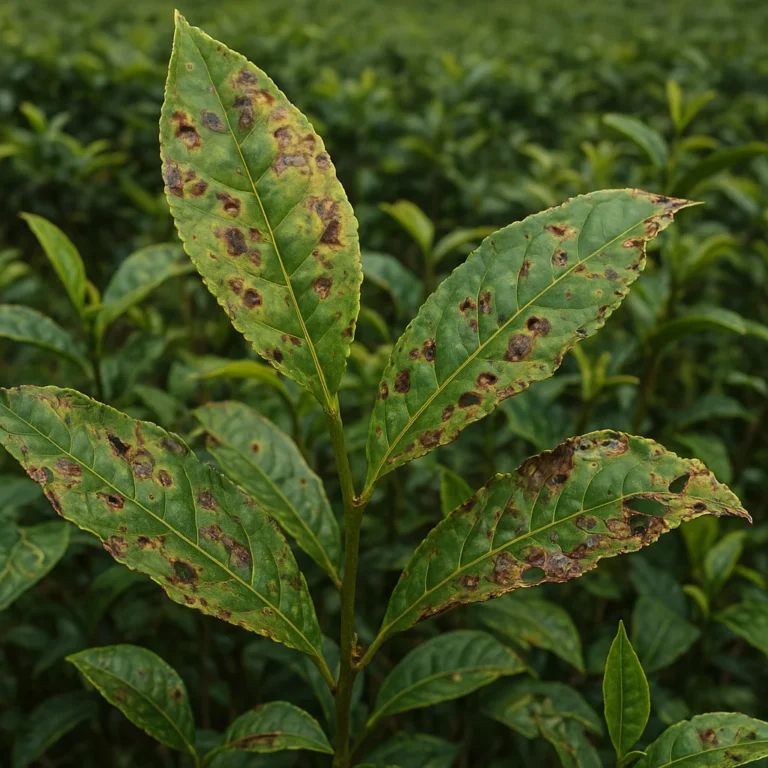
Blister blight often affects young leaves and shoots; grey blight and other leaf spots more commonly appear as dead patches on leaf blades. But look-alike symptoms are common, so record when they began and how quickly they spread. Penn State’s tea disease pages provide symptom descriptions for blister blight and algal leaf spot.
Root and stem symptoms that need attention
Root and stem problems can be easy to miss until a plant is already in serious trouble. Watch for:
- A section of the plant turning yellow while nearby plants remain healthy.
- A plant wilting even though the soil is moist.
- Weak growth, branch dieback, or sudden collapse.
- Sunken, cracked, or discolored bark near the stem base.
- Loose or decayed roots, unusual discoloration, or fungal growth on roots.
- A canker that appears to girdle a branch or stem.
Do not pull up a struggling plant just to inspect it unless you have a reason and a plan. First check the soil moisture and drainage, examine the collar, and compare symptoms with neighboring plants. If root disease is suspected, seek local diagnostic advice before disturbing the site.
Disease or nutrient deficiency? How to tell the difference
Yellow leaves are not a diagnosis. They can result from disease, poor drainage, drought, pests, nutrient imbalance, or natural leaf aging.
| Clue | More suggestive of disease | More suggestive of growing-condition stress |
|---|---|---|
| Leaf pattern | Distinct spots, lesions, blisters, or localized dead tissue | More uniform yellowing or browning |
| Distribution | One shoot, branch, or patch of plants affected first | Similar symptoms across plants with the same soil or watering conditions |
| Progression | Lesions enlarge; dieback advances; affected tissue may show fungal growth | Symptoms track watering, cold, heat, or fertilizer patterns |
| Roots and collar | Discoloration, decay, cankers, or unusual growth | Roots may be healthy but dry, waterlogged, or nutrient-stressed |
| Next step | Confirm the likely pathogen and remove infection sources as advised | Check drainage, irrigation, soil pH, and nutrient status |
These clues are not substitutes for a lab diagnosis. If symptoms are spreading quickly, involve multiple plants, or threaten a valuable planting, contact a local plant diagnostic clinic or extension service. The USDA National Plant Diagnostic Network explains how the U.S. network supports plant disease diagnostics.
Identifying Tea Plant Diseases and Getting a Diagnosis
Tea diseases have overlapping symptoms, and pathogen names can vary across regions or change as taxonomy improves. A photo is a helpful start; a diagnosis should consider the plant part, symptom pattern, local climate, and cultivation history.
A video overview can help you recognize the range of reported tea diseases, but treat its chemical recommendations as region-specific rather than universal. The featured video discusses diseases reported in Indian tea-growing areas, including blister blight, grey blight, root rots, and stem diseases. Its broad lesson—prevention, drainage, sanitation, and timely action—is useful; product choices and spray schedules need local verification.
When to consult a plant pathologist or extension service
Contact an extension office, plant clinic, or qualified plant pathologist when:
- Several plants develop similar symptoms at once.
- The plant wilts despite adequate soil moisture.
- You see collar cankers, rotting roots, or rapid dieback.
- A disease returns after pruning or treatment.
- You are considering fungicide use on a crop harvested for tea.
- You need to decide whether an infected plant or an entire planting area should be removed.
For growers in the United States, use the National Plant Diagnostic Network to find diagnostic resources. Elsewhere, contact your agricultural extension service, tea research institute, or plant-health authority.
How to collect and submit a tea plant sample
Follow the diagnostic service’s own instructions first; sample requirements differ. A useful general sequence is:
- Call or check the clinic’s website before collecting anything.
- Choose fresh, representative symptoms. Avoid tissue that is completely dead, dried, or decomposed.
- Include healthy-looking tissue beside the affected area when the clinic requests it.
- Keep leaves and roots separate. Place them in suitable packaging as directed by the clinic; do not seal wet material in a way that encourages decay.
- Photograph the whole plant, affected branch, leaf surface, leaf underside, and soil or collar.
- Write down the timeline: symptom onset, recent rain or irrigation, pruning, fertilizer use, nearby plant symptoms, and any products applied.
- Send the sample promptly and label it clearly.
If roots need inspection, don’t ship a pile of dry soil and dead fragments. Ask the lab what it wants; good samples make for better answers.
Common Leaf Diseases of Tea
Leaf diseases often attract attention first because foliage is the visible part of the harvest. Still, a spot is a symptom, not an automatic invitation to spray. Confirm the likely cause, remove avoidable infection sources, and change the conditions that favor spread.
| Disease | Typical clue | First management priority |
|---|---|---|
| Blister blight | Blister-like lesions on young leaves and shoots | Improve airflow; monitor new flush; seek region-appropriate advice |
| Grey blight | Grey or brown dead patches on leaves | Remove fallen or heavily affected material; reduce prolonged leaf wetness |
| Brown blight / leaf spot | Dark or expanding spots, often with dead centers | Check for stress and confirm diagnosis |
| Algal leaf spot | Raised grey, green, or tan spots, sometimes with green margins | Improve airflow; avoid overhead irrigation and wounding |
| Other shoot and leaf infections | Blotches, distortion, or dieback | Identify the pathogen before choosing a treatment |
1. Blister blight
Blister blight is associated with Exobasidium vexans. It can affect young tea leaves and shoots, with small pale or water-soaked marks developing into raised lesions. Lesions may become brown as they age; affected shoots can become distorted or die back. Penn State describes the disease’s characteristic blister-like symptoms and recommends less-susceptible varieties and appropriate, label-compliant fungicide protection where suitable. (Penn State PlantVillage)
What to do:
- Inspect young flush regularly, especially during wet, humid weather.
- Improve plant spacing and airflow where crowding is severe.
- Remove badly affected material where practical, without stripping healthy growth.
- Avoid overhead irrigation when it keeps foliage wet for long periods.
- Ask local tea extension experts which resistant or less-susceptible varieties and legal treatments suit your region.
The featured video discusses copper-based protection for blister blight in its Indian tea context. That should not be read as a universal prescription: copper products differ, regulations differ, and repeated use can affect soil and non-target organisms. Verify any product with your local agricultural authority and its label before use.
2. Grey blight
Grey blight is commonly associated with Pestalotiopsis species, including names used in older tea literature such as Pestalotia theae. Symptoms can include brown or greyish dead patches and premature leaf fall. The exact species and importance can differ by region, so diagnosis matters.
Management priorities:
- Remove fallen leaves and severely infected debris.
- Avoid persistent leaf wetness and improve canopy airflow.
- Protect plants from avoidable drought, nutrient imbalance, and root stress.
- If disease is severe, get local advice about a registered fungicide and the appropriate timing.
The featured video lists products such as chlorothalonil and dithianon in its regional discussion. We do not recommend copying that list blindly. Registration for tea, permitted uses, residue rules, and environmental restrictions vary by country. A product mentioned in a video may not be approved where you grow or harvest tea.
3. Brown blight and leaf spot
“Brown blight” can refer to leaf symptoms caused by different pathogens in different tea-growing regions. Brown patches can also follow injury, drought, sun exposure, or nutrient stress. That is why a clear pattern and, where necessary, diagnostic testing are more useful than relying on a disease name alone.
- Check whether spots occur on old leaves, young flush, or both.
- Look for a defined edge, concentric patterns, raised lesions, or growth on the leaf underside.
- Check the watering pattern and whether leaves remain wet overnight.
- Remove fallen diseased leaves and keep pruning tools clean.
- Avoid applying a fungicide until you know the product is labeled for tea and relevant to the suspected pathogen.
4. Red rust and algal leaf spot
Algal leaf spot, sometimes called red rust, is associated with Cephaleuros virescens. It may cause raised grey, green, or tan spots, often with a green margin. It is not a fungal disease, even though it can resemble one. Penn State recommends practices such as avoiding overhead irrigation and plant injury, improving spacing, and removing affected tissue; it also advises cutting well below visible symptoms when pruning infected material. (Penn State PlantVillage)
A practical response:
- Reduce leaf wetness and improve airflow.
- Prune affected twigs when practical, cutting well into apparently healthy tissue.
- Disinfect pruning tools between cuts.
- Remove and dispose of infected debris appropriately.
- Ask a local expert whether a protective product is needed and legally permitted.
5. Other fungal leaf spots and shoot diseases
Tea can also experience shoot blights, dieback, and leaf spots that vary with climate, cultivar, and local pathogen populations. A broad disease list may include names such as grey blight, blister blight, dieback, and pink disease, but the same visible symptom can have different causes.
A reliable sequence is:
- Photograph symptoms before pruning.
- Check the underside of affected leaves and the nearby shoot.
- Note whether symptoms began after wet weather, drought, pruning, or frost.
- Remove dead or badly infected debris, using clean tools.
- Seek a diagnosis if the disease is spreading or recurring.
For healthy tea growing beyond disease control, see our green tea cultivation and organic farming techniques resources.
Root Diseases of Tea: Identification and Control
Root diseases can be devastating because the visible warning signs often arrive late. Yellow foliage, poor growth, and wilting can signal root trouble, but they can also result from drought, waterlogging, or nutrient stress.
Penn State’s tea disease guidance describes red root disease and Phytophthora root rot among serious problems, emphasizing that root rot is difficult to manage after infection is established. (Penn State PlantVillage) The practical takeaway: preventing spread and fixing drainage are usually more dependable than trying to rescue badly rotted roots.
| Root disease group | Possible signs | Important caution |
|---|---|---|
| Black root rot | Declining growth, yellowing, root decay | Symptoms overlap with other root rots |
| Red root disease | Yellowing, wilting, red-discolored roots or fungal growth | Regional names and pathogens may differ |
| Violet root rot | Root decline with violet-colored fungal growth in some cases | Confirm before treating or replanting |
| Other root rots | Poor growth, root discoloration, plant collapse | Oomycetes and fungi require different diagnosis |
1. Black root rot
Black root rot is a name used for tea root diseases associated in some sources with Rosellinia species. Plants may decline gradually, with yellowing foliage, poor growth, or dieback. Root symptoms—not leaf color alone—are needed to support the diagnosis.
Management steps:
- Improve drainage and avoid planting in persistently wet soil.
- Remove severely affected plants and as much infected root material as local guidance recommends.
- Clean soil from tools and footwear before moving between planting areas.
- Avoid replanting tea immediately into an infested spot without expert advice.
- Ask a local tea pathologist about the pathogen and any rehabilitation or rotation options.
2. Red root rot
“Red root disease” and “brick-red root rot” are names used in tea literature for diseases associated with different fungi. Penn State describes red root disease (Poria root disease) as potentially causing yellow foliage, wilting, plant death, pale fungal growth, and red-discolored roots. Its recommendations include removing infected bushes and roots and managing nearby plants and the site with local guidance. (Penn State PlantVillage)
Important: Advice such as removing adjacent plants, digging out large roots, or leaving a cleared site fallow or in grass can be appropriate in some plantation settings but excessive for a single home-garden shrub. The scale of action should match the diagnosis and local recommendations.
3. Violet root rot
Violet root rot is reported as a root disease in some tea-growing regions, but disease names and causal organisms may not match from one region or reference to another. Violet fungal growth can be a clue; it is not a home diagnosis.
- Photograph the plant’s decline and any unusual root growth.
- Avoid moving contaminated soil or plant debris.
- Remove dead plants and roots only as advised.
- Ask a diagnostic service about safe disposal and replanting.
Do not use a soil drench just because the name sounds familiar. A wrong fungicide can fail to address the cause and may create unnecessary environmental exposure.
4. Other root rots and root-knot problems
Tea references report a range of root disorders, including oomycete root rot and root-knot nematodes. Root-knot nematodes can cause characteristic galls; other root rots cause discolored, damaged, or decaying roots. These are not interchangeable problems and may require different management.
For nematode diagnosis, inspect roots for galls and ask a laboratory or extension service to confirm. Follow current local guidance for any control product; older recommendations may involve chemicals that are restricted or no longer registered.
How to control tea root diseases
Use this sequence rather than jumping straight to a treatment:
- Check drainage. If water stands around the plant after irrigation or rain, correct the site or irrigation practice.
- Compare plants. A single declining plant suggests a localized issue; a whole row may indicate site-wide drainage or planting stress.
- Inspect the collar and roots carefully. Don’t spread soil or roots around the garden.
- Seek a diagnosis when roots show decay, unusual discoloration, fungal growth, or galls.
- Remove severely infected plants if advised, including infected root material where practical and safe.
- Sanitize tools and manage debris. Follow local disposal rules; burning is not legal or appropriate everywhere.
- Replant only after a site plan. A healthy replacement can fail quickly if the old root problem remains.
Good soil management supports recovery and prevention. Our fertilizers for tea plants and organic farming techniques resources can help with cultivation, but fertilizer cannot cure infected roots.
Stem and Trunk Diseases of Tea
Stem diseases affect the plant’s framework—the branches and trunk that support future flush. Cankers, collar damage, and wood decay can interrupt water movement, weaken branches, and eventually kill the affected section.
1. Collar canker
The collar is the lower stem where it meets the soil. A canker here can be particularly serious because it may girdle the plant or interfere with water movement. Look for sunken, cracked, discolored, or rotting bark near the soil line.
- Keep mulch and soil from piling against the stem.
- Avoid mechanical injury from tools or mowing.
- Improve drainage if the collar remains wet.
- Remove affected tissue only with a clear plan and clean tools.
- Seek local diagnosis before applying products.
The featured video associates collar canker with Phomopsis theae. Pathogen names may vary by source and region; use a local diagnostic service to confirm the causal organism before selecting a treatment.
2. Wood rot and heart rot
Wood rot affects woody tissue and may cause branch weakness, decay, or breakage. The featured video discusses wood rot associated with Hypoxylon serpens in its disease overview. A pathogen name from a regional video is not enough to confirm a case, but the visible warning signs—decaying wood, dead branches, and loss of structural strength—deserve prompt attention.
What growers can do:
- Prune dead or unsafe branches back to healthy tissue.
- Keep tools clean between cuts.
- Avoid leaving large raged wounds where careful pruning is possible.
- Remove dead wood and plant debris.
- Consult an arborist or plant pathologist if trunk decay threatens the plant’s stability.
3. Dieback, cankers, and branch infections
Cankers may begin as bark discoloration or a sunken lesion and expand until they girdle a branch. Dieback above the infection can follow. Penn State’s tea disease guidance describes camellia dieback and canker symptoms such as wilting, dead branch tips, and sunken stem lesions, and recommends pruning affected twigs several inches below cankers and disinfecting tools between cuts. (Penn State PlantVillage)
Pruning procedure:
- Work in dry weather when practical.
- Cut several inches below visible canker tissue, into healthy-looking wood.
- Inspect the cut surface; if discoloration continues, recut lower.
- Disinfect blades between cuts and between plants.
- Remove infected prunings from the growing area.
- Avoid excessive pruning that removes too much productive canopy.
How to manage tea stem diseases
Stem disease control combines sanitation, careful pruning, and avoiding injuries:
- Remove dead or infected branches promptly.
- Keep tools sharp and disinfected.
- Avoid damaging trunks, branches, and the collar.
- Maintain appropriate soil moisture and drainage.
- Don’t seal or paint wounds with unverified products.
- Get professional advice for trunk cankers, collar rot, or widespread dieback.
For tools, choose durable pruning shears from established brands such as Felco or ARS. Tool quality can make clean cuts easier, but no brand replaces sanitation.
Integrated Disease Management for Tea Plants
Integrated disease management means combining prevention, monitoring, sanitation, and targeted treatments—not reaching for the strongest spray at the first brown spot. It also means accepting that some root diseases cannot be cured once plants are badly infected.
| Practice | What it helps with | Limitations |
|---|---|---|
| Drainage and soil care | Reduces root stress and waterlogging | Won’t cure existing severe root rot |
| Pruning and sanitation | Removes infected tissue and improves airflow | Poor pruning can spread infection or weaken plants |
| Resistant or less-susceptible varieties | Lowers disease risk for some pathogens | Availability and performance vary by region |
| Biological controls | May support soil health or suppress some pathogens | Results depend on strain, application, and conditions |
| Fungicides | Can protect against particular diseases when properly timed | Must be registered and correctly labeled; not all diseases respond |
| Diagnosis and monitoring | Prevents misdirected treatment | Requires good samples and timely action |
Prevention through site selection and soil care
Before planting, choose a site with suitable drainage, good light for the cultivar and climate, and adequate air movement. Tea prefers acidic growing conditions, but the exact soil-management plan should be guided by local recommendations and testing. The University of Hawaiʻi’s tea-growing guide offers cultivation context, while University of Georgia Extension’s camellia guide covers related ornamental camellia care.
- Avoid low spots where water collects.
- Don’t plant too closely for the cultivar’s mature size.
- Use irrigation that targets the root zone.
- Keep the collar free of persistently wet mulch.
- Use healthy, disease-free planting material.
Pruning, sanitation, and infected-plant removal
Sanitation is one of the most useful low-tech tools we have. Remove fallen leaves and dead branches, clean tools, and avoid carrying contaminated soil from one bed to another.
A sensible sanitation routine:
- Inspect plants before pruning.
- Remove dead or confirmed diseased tissue first.
- Clean blades between plants and between suspicious cuts.
- Collect prunings rather than leaving them beneath the canopy.
- Dispose of infected material according to local rules.
Penn State recommends pruning infected tissue and disinfecting tools for camellia dieback and canker, and removing disease-conducive debris for several tea diseases. (Penn State PlantVillage)
Resistant varieties and healthy planting material
Where a disease is common, choosing a less-susceptible cultivar can be more reliable than repeatedly treating a highly susceptible one. Availability depends on whether you’re growing tea as a commercial crop, a garden shrub, or a small home tea patch.
Ask a reputable nursery or regional tea authority:
- Is the plant correctly identified as Camellia sinensis?
- Is the cultivar suited to your local climate?
- Is it known to be less susceptible to a disease in your region?
- Was the plant raised in clean media and inspected for pests and disease?
For broader tea-growing guidance, browse Green Tea Cultivation and Herbal Tea Planting. Tea itself is not a herbal tea plant in the botanical sense; that category is useful for readers planning a mixed tea garden, not as a source of tea-disease diagnosis.
Biological controls and beneficial soil microbes
Some tea-growing programs use beneficial microbes such as Trichoderma species as part of soil management. The featured video mentions Trichoderma harzianum and T. viride in soil rehabilitation discussions. These organisms may be useful in an integrated program, but performance depends on strain, product quality, timing, soil conditions, and the pathogen involved.
- Choose a reputable, correctly identified product.
- Check that it is registered or permitted for the intended use.
- Follow storage and application instructions; living organisms can be damaged by heat or poor storage.
- Don’t assume a biological product will eradicate established root disease.
Our organic farming techniques category covers broader low-impact approaches. “Organic” does not mean “risk-free,” and biological controls still need correct use.
Fungicides: safe, legal, and targeted use
Fungicide recommendations are particularly prone to regional mismatch. The featured video mentions products and active ingredients used in Indian tea contexts, while Penn State gives broader advice to use appropriate protective or systemic fungicides where indicated. These sources can differ because of local registration, pathogen populations, climate, crop practices, and product labels.
Before using any fungicide:
- Confirm the disease as far as practical.
- Check that the product is labeled for tea and the disease.
- Follow the label exactly, including protective equipment, application interval, and harvest restrictions.
- Follow local residue, environmental, and worker-safety regulations.
- Avoid spraying during bloom or when pollinators may be exposed unless the label and local advice permit it.
- Don’t mix products unless the label explicitly supports the mixture.
We’re not listing spray rates here: a rate suitable for one formulation or jurisdiction may be wrong or illegal elsewhere. Contact your local agricultural extension service or tea research authority for current recommendations.
A seasonal tea garden disease-prevention checklist
| When | What to check |
|---|---|
| Before new growth | Drainage, mulch around collars, dead branches, plant spacing |
| During wet periods | New flush, blister-like lesions, leaf wetness, fallen infected leaves |
| After pruning | Clean cuts, disinfected tools, fresh cankers, wound damage |
| During dry weather | Irrigation consistency, leaf scorch, stressed shoots, soil moisture |
| At harvest or plucking | Unusual lesions, distorted shoots, pest signs, harvest hygiene |
| At season’s end | Plant decline patterns, root-zone drainage, debris removal, records |
Common Tea Disease-Control Mistakes to Avoid
❌ Treating every yellow leaf as fungus. Yellowing can follow poor drainage, drought, nutrient stress, pests, or natural aging.
❌ Adding water to a wilted plant without checking the soil. A waterlogged plant can wilt because damaged roots cannot take up water properly.
❌ Spraying a product because a video or article named it. The product may not be registered for tea where you live, and it may target the wrong pathogen.
❌ Pruning cankers with dirty tools. Clean blades between cuts; Penn State specifically recommends tool disinfection for canker management. (Penn State PlantVillage)
❌ Leaving infected debris beneath the plant. Remove diseased leaves and dead branches when practical, following local disposal rules.
❌ Replanting immediately into a site with severe root disease. Some pathogens can persist in old roots or infested soil. Get local replanting advice first.
❌ Overfertilizing a sick plant. More fertilizer cannot repair rotted roots and may add stress. Test soil and follow a tea-specific nutrient plan; see our fertilizers for tea plants guide.
❌ Using one symptom photo as a definitive diagnosis. Send clear images, a symptom timeline, and a representative sample to a diagnostic service when stakes are high.
Tea Disease Management by Climate and Growing Setup
The same disease can behave differently in a humid plantation, a dry garden, and a greenhouse. Match management to the conditions you actually have.
Humid and rainy regions
In wet climates, focus on how quickly foliage and soil dry:
- Improve canopy airflow without stripping too much shade.
- Avoid overhead watering, particularly late in the day.
- Keep drainage channels clear in larger plantings.
- Inspect young flush after extended wet weather.
- Remove fallen and infected debris promptly.
- Use local disease alerts and tea research guidance when available.
The UPASI Tea Research Foundation’s pests and diseases resource covers tea health concerns in its South Indian context. It includes extensive pest guidance as well, which matters because mite or insect damage can be mistaken for disease.
Home gardens, containers, and greenhouses
Small-scale growing makes observation easier, but containers can swing from waterlogged to bone-dry surprisingly fast.
- Use containers with drainage holes.
- Don’t let the pot stand in water.
- Choose a free-draining, acidic growing medium suitable for tea.
- Give foliage enough space and airflow.
- Water the root zone; avoid repeatedly weting the leaves.
- Isolate a newly purchased plant if it arrives with suspicious symptoms.
- Clean pruning tools and remove fallen leaves from the pot surface.
For container and home tea-growing context, explore Green Tea Cultivation. If the problem might be a pest rather than a pathogen, compare symptoms with our guide to common tea pests and diseases.