Support our educational content for free when you purchase through links on our site. Learn more
Tea Pests & Diseases: Long-Term Yield and Quality Risks 🍃

What are the long-term effects of pest and disease infestations on tea plant yield and quality? Repeated infestations can reduce harvests by damaging shoots, stripping leaves, weakening branches, or harming roots. They can also make leaf quality and harvests less consistent, though damaged bushes don’t automatically produce tea with a permanently altered flavor.
We’ve seen growers blame slow flush on everything from poor fertilizer to fickle weather. Sometimes the clue is smaller: curled young leaves, fresh feeding marks, or a patch of bushes that keeps falling behind. Spoting the cause early—and checking whether your response works—is more useful than reaching for a spray on sight.
Key Takeaways
- Recurring damage can compound: repeated leaf, shoot, stem, or root injury may slow recovery and reduce harvestable growth over time.
- Yield and cup quality are different measures: infestations can reduce the amount and consistency of suitable leaf without necessarily changing the flavor of every healthy shoot.
- The culprit matters: pests, diseases, and growing stresses can cause similar symptoms, so inspect carefully and seek local diagnosis when needed.
- Prevention starts with plant health: regular scouting, sanitation, good drainage, balanced nutrition, and suitable shade support stronger recovery.
- Use targeted, locally approved controls: integrated pest management helps address the cause while avoiding unnecessary harm to beneficial organisms.
Table of Contents
- ⚡️ Quick Tips and Facts: Tea Pest and Disease Impacts
- 🌱 Background: Why Tea Plant Health Shapes Yield and Quality
- 📉 How Infestations Change Tea Yield Over Time
- Immediate crop losses versus cumulative damage
- Effects on shoot growth, plucking rounds, and bush recovery
- Yield resilience, tea bush age, and growing conditions
- 🍃 Long-Term Effects on Tea Leaf Quality and Cup Character
- Changes to leaf appearance, size, and tenderness
- Effects on flavor, aroma, color, and processing performance
- What pest and disease damage means for tea grades and marketability
- 🔎 Tea Pests and Diseases: Damage Pathways and Lasting Consequences
- 1. Sap-feding insects and mites
- 2. Leaf-chewing and leaf-ming pests
- 3. Stem borers, scale insects, and branch pests
- 4. Root pests and soil-borne damage
- 5. Fungal leaf diseases and blights
- 6. Stem cankers and dieback diseases
- 7. Root rot and other root diseases
- 8. Viral, bacterial, and other emerging diseases
- 🌳 The Hidden Costs: Bush Decline, Replanting, and Farm Economics
- Reduced productive lifespan and uneven tea fields
- Rising labor, control, and replacement costs
- Effects on smallholders, estates, and tea supply chains
- 🌧️ What Makes Long-Term Damage Worse?
- Climate, humidity, rainfall, and temperature
- Soil health, shade, drainage, and plant nutrition
- Tea cultivar susceptibility and planting density
- Monoculture, neglected pruning, and repeated outbreaks
- 🛡️ Integrated Pest and Disease Management for Tea
- Scouting, identification, and damage monitoring
- Cultural controls: pruning, sanitation, shade, and drainage
- Biological control and beneficial organisms
- Resistant cultivars and healthy planting material
- Responsible pesticide use and resistance prevention
- 📊 Measuring Recovery: Yield, Quality, and Plant Health Indicators
- 🧭 A Practical Long-Term Prevention and Recovery Plan
- ✅ Quick Tips for Protecting Tea Yield and Quality
- Conclusion
- Recommended Links
- FAQ
- Reference Links
⚡️ Quick Tips and Facts: Tea Pest and Disease Impacts
- Long-term damage is usually cumulative: repeated leaf loss, shoot injury, branch dieback, and root stress can shrink the productive canopy and slow recovery after pruning.
- Yield and cup quality are related, but not interchangeable. A damaged bush may produce fewer pluckable shoots; that does not automatically mean every surviving leaf tastes worse. Quality effects depend on the pest or pathogen, the affected leaf material, harvest standards, and processing.
- Early action beats dramatic action. Scout regularly, identify the likely cause, and track whether damage is spreading before choosing a control. The University of California Statewide IPM Program recommends integrated pest management based on monitoring and selecting controls appropriate to the pest and crop.
- Do not copy pesticide recipes from old videos or articles. Products and permitted uses differ by country, crop, pest, and label. Follow local tea-crop regulations and the product label, or consult an agricultural extension officer.
- Start with the growing conditions. Good drainage, balanced nutrition, suitable shade, sanitation, and well-timed pruning help tea bushes tolerate stress. See our guides to Fertilizers for Tea Plants and Organic Farming Techniques.
- For a field guide to likely culprits, see our article on common pests and diseases that affect tea plants.
| At a glance | What it means for a tea garden |
|---|---|
| Yield risk | Fewer healthy shoots, slower flush recovery, and gaps in the plucking surface |
| Quality risk | Damaged or uneven shoots can complicate plucking and processing; effects on flavor vary |
| Most useful first step | Identify the pest or disease and map how much of the bush or block is affected |
| Best long-term approach | Integrated pest management, not repeated blanket spraying |
| Recovery outlook | Mild foliage damage may recover; severe stem, root, or repeated canopy damage may leave lasting losses |
🌱 Background: Why Tea Plant Health Shapes Yield and Quality

Tea is harvested for tender shoots, so the plant’s productive engine is also the part we keep asking it to grow. When pests or diseases damage buds, young leaves, stems, or roots, the bush may have less healthy foliage to support new flush. The result can be fewer harvestable shoots, uneven growth, and a longer path back to normal production.
The long-term story depends on where the damage occurs:
- Leaf and bud damage removes or deforms harvestable material.
- Stem and branch damage can interrupt growth, cause dieback, or break productive branches.
- Root damage can limit water and nutrient uptake, weakening growth above ground.
- Repeated defoliation or disease can reduce the bush’s capacity to rebuild its canopy between harvests.
The FAO’s tea-related agricultural resources and regional tea research organizations provide crop-specific context, while the CABI BioProtection Portal summarizes common tea pests and their damage. The exact losses vary by region, cultivar, weather, pest pressure, and garden management. A single dramatic outbreak tells us what a pest can do; it does not establish a universal long-term yield percentage.
What “long-term effects” means in practice
We use “long-term” to mean more than one damaged flush. It may include:
- A delayed recovery after an outbreak or pruning.
- Repeated seasonal damage that prevents the canopy from rebuilding fully.
- Persistent dieback or root decline that reduces the productive framework.
- Ongoing losses across a block that change labor needs, harvest consistency, or replanting plans.
This distinction matters. A few curled leaves are not the same as a repeatedly defoliated bush, and neither should be treated like a branch tunneled through by a borer. We once inspected a small garden where the grower blamed pale leaves on a “bad fertilizer.” A closer look showed pest activity concentrated on young growth. The lesson was simple: symptoms are clues, not diagnoses.
Yield loss and quality loss: related, but not identical
Yield refers to the amount of harvestable crop. Quality refers to the characteristics and suitability of the harvested leaf and made tea. Pest damage may reduce yield without permanently changing the flavor of every healthy leaf left on the bush. Conversely, damaged, contaminated, or poorly developed shoots may be unsuitable for a preferred grade even if total bush growth appears substantial.
For growing healthy tea plants and planning cultivation practices, explore Green Tea Cultivation and Herbal Tea Planting. Tea is Camellia sinensis; “herbal tea” usually refers to infusions made from other plants, so the cultivation needs can differ.
📉 How Infestations Change Tea Yield Over Time
Immediate crop losses versus cumulative damage
A severe attack can reduce the current harvest by destroying tender shoots or removing leaves. Long-term losses arise when damage repeats, recovery takes longer, or the bush loses parts of its productive structure.
| Damage pattern | Near-term effect | Possible longer-term consequence |
|---|---|---|
| Bud and young-shoot feeding | Deformed or dried shoots; fewer suitable plucks | Fewer flushes available for harvest if damage recurs |
| Leaf feeding or defoliation | Less healthy leaf area | Slower canopy rebuilding and increased pressure on remaining foliage |
| Branch tunneling or cankers | Wilt, dieback, branch weakening | Loss of productive framework or branch breakage |
| Root feeding or root disease | Stunting, yellowing, weak growth | Reduced vigor and a prolonged recovery period |
| Repeated leaf disease | Lesions and premature leaf drop | Patchy canopy and reduced consistency across the block |
The UPASI Tea Research Foundation’s pest and disease resources describe pests that damage shoots, foliage, roots, and branches. The source identifies potential damage but does not provide a universal long-term yield-loss estimate for each pest. That is sensible: a percentage without location, cultivar, infestation level, and time period can be more misleading than helpful.
Effects on shoot growth, plucking rounds, and bush recovery
Tea growers depend on regular flushes of young shoots. If pests damage buds or tender leaves, the plucking surface may become uneven. If branch or root injury is involved, the plant may also take longer to produce vigorous replacement growth.
Watch for:
- Fewer or shorter shoots at normal inspection intervals.
- Increasing gaps or bare patches in the plucking table.
- Delayed regrowth after pruning.
- More shoots that are curled, scared, stunted, or unsuitable for the intended harvest.
- A widening difference between affected and unaffected rows.
A single missed flush can be frustrating; several disrupted flushes can change the season’s harvest rhythm. Still, don’t assume every slow flush is caused by pests. Drought, waterlogging, nutrient imbalance, shade changes, and pruning timing can produce overlapping symptoms. Our tea plant fertilizer guide can help you assess nutrition, but fertilizer is not a cure for insects, fungi, or damaged roots.
Yield resilience, tea bush age, and growing conditions
Healthy, established bushes may tolerate some leaf loss better than young or already stressed plants. Young bushes have less reserve structure, while old bushes may have reduced vigor or accumulated damage. Soil condition, rainfall, drainage, shade, cultivar, and pruning strategy all affect recovery.
This is why the same pest count can have different consequences in two gardens. A well-drained, vigorous block may replace modest foliage damage quickly. A waterlogged or drought-stressed block may struggle. The FAO’s soil and water management resources offer broader guidance on the foundations of crop resilience.
🍃 Long-Term Effects on Tea Leaf Quality and Cup Character
Changes to leaf appearance, size, and tenderness
Pests and diseases can produce browning, stipling, curling, mining, roughness, premature drying, or leaf drop. These signs matter because tea production relies on healthy, tender shoots. If new growth becomes leathery, misshapen, or uneven, the harvested material may no longer match the desired plucking standard.
Common warning signs include:
- Pale stipling or bronzing: often associated with sap-feding mites or insects.
- Curled or cupped leaves: may follow feeding on buds and young growth.
- Mines, holes, or skeletonized areas: suggest feeding inside or on leaf tissue.
- Dark surface growth: may be soty mold associated with honeydew-producing insects.
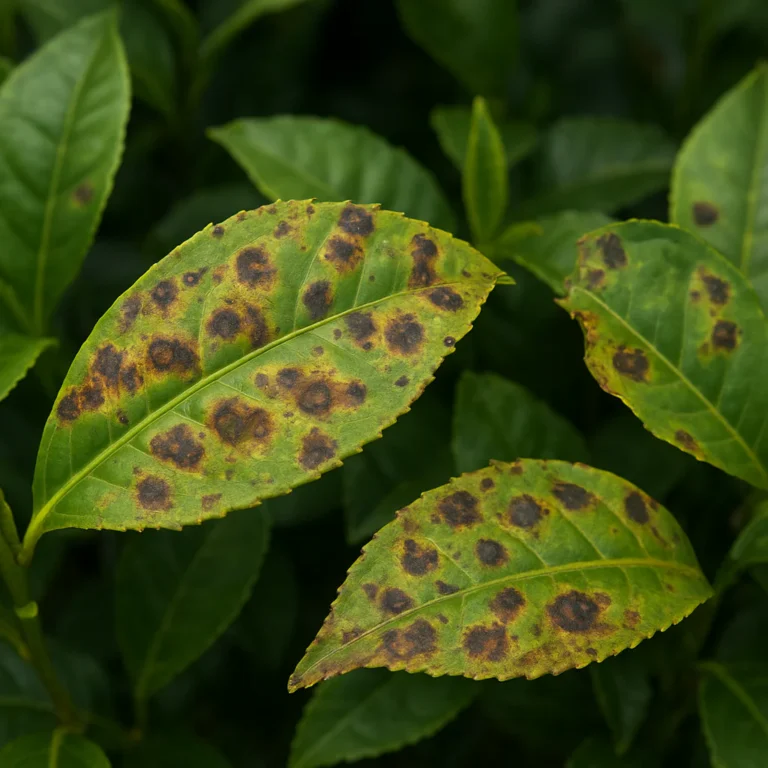
- Spots, lesions, or blights: may indicate disease, though diagnosis should be confirmed.
The CABI BioProtection Portal’s tea pest guide describes several of these visible symptoms. But visual symptoms can overlap. Photograph affected leaves, check both leaf surfaces, inspect nearby stems, and compare affected bushes with healthy ones before deciding what you’re dealing with.
Effects on flavor, aroma, color, and processing performance
There is no single “pest-damaged tea flavor.” The outcome depends on which leaves are harvested, how much damage they have sustained, the tea style, and how the material is processed. A garden with reduced or uneven flush may create harvest inconsistency, while badly damaged shoots may be excluded during sorting or fail to meet a quality specification.
We recommend separating three questions:
- Did the infestation reduce the amount of harvestable leaf?
- Did it change the physical condition of the harvested shoot?
- Did sensory evaluation or processing show a repeatable change?
Without a controlled comparison, it is easy to blame a flavor change on pests when weather, plucking interval, withering, oxidation, firing, or storage may be responsible. For broader tea-cup context, see our Health Benefits of Tea category; it covers tea as a beverage, not a substitute for diagnosing crop quality.
What pest and disease damage means for tea grades and marketability
Buyers may care about leaf condition, consistency, cleanliness, and the product’s intended style. Damaged leaves can be less suitable for some grades, and extensive pest pressure may complicate sorting and processing. However, grading systems vary, so growers should use the applicable buyer specifications and local standards rather than assume a universal penalty.
| Observation | Potential concern | Practical check |
|---|---|---|
| Deformed or leathery shoots | Plucking standard may be harder to maintain | Compare shoot size and tenderness with unaffected rows |
| Leaf spots or lesions | Visible defects or disease spread | Record incidence and request a local diagnosis |
| Honeydew and soty mold | Leaf surface contamination and reduced photosynthesis | Inspect for aphids, scales, or other sap-feders |
| Uneven flush | Inconsistent harvest timing | Track plucking intervals and block-level yield |
| Repeated rejection or downgrading | Marketability and revenue risk | Review buyer criteria and keep harvest records |
🔎 Tea Pests and Diseases: Damage Pathways and Lasting Consequences
Pest names and scientific classifications can vary between regions and sources, and several unrelated problems can look alike at first glance. The descriptions below explain damage patterns, not a diagnosis for every tea garden.
1. Sap-feding insects and mites
Tea mosquito bugs, thrips, aphids, jassids, and mites feed on plant tissues or sap. Damage may include stipling, bronzing, curled leaves, deformed buds, yellowing, or dried shoots. Heavy or recurring pressure can reduce healthy leaf area and interfere with flush development.
- Tea mosquito bug (Helopeltis species): feeding can leave reddish-brown marks and damage buds, leaves, and tender stems.
- Mites: some feed on mature foliage; others affect young leaves and buds. Severe activity may cause bronzing, curling, drying, or leaf fall.
- Thrips: feeding on tender tissue may leaves curled or rough.
- Aphids: colonies on young growth may cause curling and produce honeydew, which can support soty mold.
- Jassids: feeding can contribute to yellowing, marginal browning, and leaf cupping.
The UPASI resource describes tea pests including mites, thrips, aphids, and jassids, while CABI’s tea pest overview provides a second practical perspective. A pest may be present without being the main cause of poor growth; confirm its abundance and the pattern of damage before taking action.
2. Leaf-chewing and leaf-ming pests
Caterpillars can chew leaves, skeletonize foliage, roll leaves, or feed within leaf tissue. Severe defoliation can leave a bush with little healthy canopy, while repeated attacks may interrupt its ability to rebuild.
Examples reported in tea-growing resources include loopers, leaf rollers, flushworms, and other caterpillars. The UPASI pest and disease guide describes cases where severe caterpillar feeding can strip bushes. That language describes high-pressure situations, not the expected result of every caterpillar sighting.
Look for:
- Fresh chewing and frass.
- Roled, webed, or tied leaves.
- Larvae concealed on the underside of leaves or among shoots.
- Clusters of bare or skeletonized foliage.
- New damage appearing between inspections.
Manual removal may be practical in a small garden when infestation is localized, but it is not a realistic stand-alone method for a large estate. Preserve beneficial insects and follow local guidance for any additional control.
3. Stem borers, scale insects, and branch pests
Borers tunnel into woody stems or branches. Other pests may weaken plant tissues or contribute to decline. Shot-hole borer damage, for example, may be associated with holes, galleries, branch weakening, dieback, or breakage. Once a productive branch is badly compromised, foliage-level remedies cannot repair the damaged wood.
Inspect for:
- Small holes or frass on branches.
- Wilting isolated to one branch.
- Suden dieback above a damaged section.
- Cracks, cankers, or weakened branch junctions.
- Affected stems concentrated in particular rows or areas.
UPASI’s tea pest resources recommend assessing affected growth and removing damaged material in relevant cases. Pruning to sound tissue may help limit an affected branch, but tools should be sanitized when disease is suspected, and removed material should be disposed of according to local plant-health advice.
4. Root pests and soil-borne damage
Root-knot nematodes, white grubs, root-feding insects, and root diseases can weaken bushes below the surface. Above-ground signs may include yellowing, stunting, poor response to rain or fertilizer, uneven growth, or gradual decline.
Root problems are especially easy to misread. A weak bush may appear hungry even when adding fertilizer will not fix the underlying issue. Check:
- Whether symptoms follow wet or compacted soil areas.
- Whether nearby bushes show a similar pattern.
- Root condition, if examination can be done without harming a valuable plant.
- Drainage, irrigation, and soil history.
- Local laboratory or extension diagnosis for persistent decline.
The University of California IPM root-knot nematode guide describes how these microscopic pests affect roots in susceptible crops. Tea-specific recommendations should come from local tea research or extension services.
5. Fungal leaf diseases and blights
Fungal diseases can cause spots, blights, lesions, or leaf drop. Persistent infection may reduce healthy leaf area, especially when weather favors disease and sanitation or canopy conditions allow it to spread. A fungal-looking spot is not proof of a fungus; insects, sun injury, nutrient disorders, and chemical damage can create similar marks.
Use a simple diagnostic sequence:
- Photograph the symptom on the plant and close up.
- Record where it occurs: young or mature leaves, tips, margins, or whole bushes.
- Check weather and management history, including recent rain, spraying, or pruning.
- Look for spread patterns across rows or low-lying wet areas.
- Seek a local plant-health diagnosis before applying a fungicide.
The American Phytopathological Society provides plant disease education and research resources. Tea-specific disease identity and control depend on local conditions.
6. Stem cankers and dieback diseases
Stem cankers and other diseases affecting woody tissues can cause localized lesions, cracking, wilting, dieback, or branch death. If the main stem or major framework is involved, losses can persist beyond one flush because the plant has to rebuild structure, not just leaves.
Practical steps include:
- Mark affected bushes and monitor whether the lesion expands.
- Avoid moving contaminated plant material through the garden.
- Use clean tools and follow local sanitation recommendations.
- Remove severely affected material only when advised and dispose of it safely.
- Check whether poor drainage, injury, or stress may be contributing.
7. Root rot and other root diseases
Root rot is often linked with unfavorable soil conditions, including prolonged saturation, though the precise cause requires diagnosis. Declining roots can reduce water and nutrient uptake, leaving foliage yellow, weak, or sparse. If wet conditions persist, recovery may be limited until the site problem is corrected.
Drainage is not glamorous, but it is often more useful than another bottle in the spray shed. Correcting standing water, compaction, or poorly managed irrigation can reduce ongoing stress. Avoid applying generic fungicides without confirming the cause and checking local product approval.
8. Viral, bacterial, and other emerging diseases
Viruses, bacteria, and newly recognized pathogens may cause unusual patterns of discoloration, distortion, wilt, or decline. Some can be spread through planting material, vectors, tools, or contaminated debris. Because symptoms overlap, unusual or rapidly spreading cases merit expert diagnosis.
Use certified or reputable planting material where available, keep records of new plants, and ask a local tea research service about suspected outbreaks. The International Plant Protection Convention provides international information on plant health and pest movement.
🌳 The Hidden Costs: Bush Decline, Replanting, and Farm Economics
Reduced productive lifespan and uneven tea fields
Severe or recurring injury can leave gaps in the plucking surface and create uneven blocks. Some bushes may recover, others may remain weak, and a few may need replacement. Uneven growth complicates harvest timing and can increase the labor needed to maintain quality.
The economic effect depends on more than crop weight:
- Lost or delayed harvests.
- Extra scouting and pruning.
- Sorting or rejecting damaged shoots.
- Treatment and sanitation labor.
- Replacement planting and the time needed for young bushes to become productive.
- Reduced uniformity across a block.
Rising labor, control, and replacement costs
Repeated outbreaks can drive a cycle of reactive treatment. That can cost time, labor, and beneficial organisms, while failing to fix the cause if the real problem is poor drainage, unsuitable shade, or an incorrectly identified pest.
We recommend keeping a basic block record:
| Record | Why it helps |
|---|---|
| Pest or disease symptoms and date | Reveals seasonal recurrence |
| Affected bushes or area | Shows whether the problem is expanding |
| Weather and soil conditions | Helps connect outbreaks with environmental stress |
| Pruning and plucking dates | Explains variation in regrowth |
| Treatments and results | Identifies what helped and what did not |
| Harvest volume and quality notes | Measures the practical impact |
Effects on smallholders, estates, and tea supply chains
Smallholders may have fewer resources for diagnostic testing or repeated field visits, while estates may face the challenge of coordinating action across large areas. Both benefit from locally shared monitoring, clear records, and regionally suitable recommendations. Neighboring gardens can also affect pest movement, making communication and coordinated sanitation useful.
Broad figures should be read carefully. The CABI BioProtection Portal reports substantial pest-related losses in tea production in India, but such figures are context-specific and should not be treated as a predicted loss for every farm or season. The article does not supply one universal model for translating an infestation into a long-term yield or taste penalty.
🌧️ What Makes Long-Term Damage Worse?
Climate, humidity, rainfall, and temperature
Weather affects both tea growth and pest or disease pressure. Warm, humid, or rainy conditions may favor some pests and pathogens; dry conditions may stress bushes and make certain pests more damaging. The relationship is pest-specific, so local monitoring matters more than a one-size-fits-all calendar.
Soil health, shade, drainage, and plant nutrition
Poor drainage can stress roots; excessive shade or poor canopy airflow may alter disease pressure; nutrient imbalance can weaken growth or mimic disease symptoms. Shade also has trade-offs: it can reduce stress in some situations, yet dense, damp conditions may favor other problems.
The FAO soil portal offers broad soil-health guidance. For tea-specific planting and care, see Green Tea Cultivation and Fertilizers for Tea Plants.
Tea cultivar susceptibility and planting density
Tea cultivars differ in growth habits and susceptibility to particular pests or diseases. Dense planting can make inspection harder and may affect airflow and spray coverage. Where replanting is planned, ask local tea specialists about cultivars that perform well under the garden’s conditions and have useful disease-resistance traits.
Monoculture, neglected pruning, and repeated outbreaks
Large areas of a single crop can provide a steady host for specialized pests. Neglected pruning, unmanaged weeds, poor sanitation, and repeated use of the same control method can also worsen problems. Integrated management is not a magic shield; it is a way to reduce the conditions that let a problem return unchecked.
🛡️ Integrated Pest and Disease Management for Tea
IPM combines observation, prevention, biological and cultural controls, and carefully selected treatments when needed. The FAO’s integrated pest management resources describe the general approach: manage pests with a combination of methods, while considering crop health, environment, and economic practicality.
Scouting, identification, and damage monitoring
Scout on a consistent schedule, especially during active flush and after weather or pruning events that may change pest pressure.
Step-by-step field check:
- Walk a repeatable route through the garden rather than inspecting only the easiest bushes.
- Sample plants from edges, interior rows, wet spots, shaded sections, and previously affected areas.
- Inspect both surfaces of leaves, buds, tender stems, branch junctions, and the base of plants.
- Note live pests, fresh feeding damage, eggs or larvae where visible, and natural enemies.
- Map affected bushes and compare with a healthy reference area.
- Recheck after an appropriate interval to determine whether damage is increasing.
Sticky traps can help monitor certain flying insects but do not replace leaf and stem inspection. Take photos, collect a sample if appropriate, and seek local identification when uncertain.
Cultural controls: pruning, sanitation, shade, and drainage
Cultural practices can reduce pest reservoirs and help bushes recover:
- Remove heavily damaged or diseased material when local guidance supports it.
- Prune at suitable times and avoid leaving infected debris in the garden.
- Keep drainage channels functioning and avoid persistent waterlogging.
- Manage shade and weeds with the crop’s local requirements in mind.
- Maintain nutrition based on soil or plant assessment rather than guesswork.
- Clean tools between suspect plants when disease spread is possible.
These measures are foundational, not instant cures. A branch already girdled by a borer will not heal because the weeds were tidied.
Biological control and beneficial organisms
Natural enemies such as predatory mites, ladybird beetles, parasitoids, and other beneficial organisms can help suppress some pest populations. Broad-spectrum insecticides may harm these allies, so preserve them where possible and confirm that a proposed treatment is compatible with biological control.
The CABI BioProtection Portal provides information on biological and lower-risk pest management options. Availability and registration differ by country and crop.
Resistant cultivars and healthy planting material
Use healthy planting stock from reliable sources, and ask local tea research organizations about varieties suited to your region. Resistant or tolerant cultivars may reduce risk, but no cultivar is immune to every pest, disease, or stressful growing condition.
Responsible pesticide use and resistance prevention
Some older tea pest resources list active ingredients or application rates that may be outdated, restricted, or unsuitable in a particular country. Do not treat historical recommendations as current instructions. A product must be approved for the crop and target pest in your jurisdiction, and the label must be followed.
If chemical control is justified:
- Confirm the pest or disease first.
- Check local registration and label directions.
- Protect workers, pollinators, beneficial organisms, water, and harvested leaf.
- Observe pre-harvest intervals and protective-equipment requirements.
- Rotate modes of action only as allowed by local guidance.
- Keep records and assess whether the treatment actually worked.
For organic production, certification rules matter as much as product identity. “Natural” does not automatically mean safe, effective, or permitted. Review our Organic Farming Techniques resources and confirm requirements with your certifier.
📊 Measuring Recovery: Yield, Quality, and Plant Health Indicators
Recovery should be measured over time, not judged by one flush. Choose a consistent set of indicators and compare affected bushes with healthy bushes managed under similar conditions.
| Indicator | What to record | Signs of improvement |
|---|---|---|
| Canopy condition | Leaf cover, bare patches, leaf color | New healthy foliage and fewer expanding patches |
| Shoot growth | Number, length, and condition of harvestable shoots | More uniform, tender flush |
| Branch health | Dieback, bore holes, cracking, breakage | No new dieback and stable branch structure |
| Root-zone conditions | Drainage, soil moisture, visible root health where checked | Less waterlogging or persistent drought stress |
| Pest or disease activity | Live pest counts or symptom incidence | Lower or stable activity, less fresh damage |
| Harvest performance | Block-level harvest records | Recovery relative to comparable healthy blocks |
| Quality observations | Plucking condition, sorting notes, buyer feedback | Fewer defective shoots and improved consistency |
When possible, use the same observation method each time. A small sample of marked bushes can provide a more useful trend than a vague memory of “the field looked greener last month.” For commercial production, coordinate records with agronomists, extension officers, or tea research organizations.
🧭 A Practical Long-Term Prevention and Recovery Plan
Step 1: Confirm what is happening
Describe the symptom before naming the cause. Is the damage on young or mature leaves? Is it clustered in wet areas, near the edge, or across an entire block? Are pests visible? Does the pattern follow pruning, weather, irrigation, or a recent treatment?
Step 2: Estimate the scale
Mark a sample of affected and apparently healthy bushes. Record the approximate share affected, the severity, and whether new damage is appearing. This establishes a baseline.
Step 3: Reduce avoidable stress
Check drainage, irrigation, shade, pruning practice, nutrition, and weeds. Correct clear growing-condition problems, but avoid making several major changes at once; otherwise, you won’t know what helped.
Step 4: Choose targeted controls
Use sanitation, manual removal, biological controls, or locally approved pesticides according to the diagnosis and scale. Follow local expert advice, especially for root disease, branch borers, and unusual symptoms.
Step 5: Reassess and learn
Return to the same marked plants. Did new damage slow? Did shoot growth improve? Did beneficial insects remain present? Keep the answer, even if the answer is “that treatment didn’t help.” Failed guesses are expensive; recorded failures become useful information.
Step 6: Plan for the next season
Adjust scouting dates, pruning, planting material, drainage, or shade management based on the garden’s history. The goal is not to eliminate every insect from a tea field. It is to prevent damaging populations and disease pressure from repeatedly eroding the bush’s ability to produce.
In the first YouTube video about tea pests, the presenter walks through symptoms associated with tea mosquito bug, leaf-feding caterpillars, borers, mites, thrips, and aphids. It can help viewers recognize what to look for, but it also repeats pesticide recipes, including older active ingredients. Treat the video as a visual identification aid, not a current pesticide-use guide; product registration, safety, and permitted tea-crop uses must be checked locally.
✅ Quick Tips for Protecting Tea Yield and Quality
- Inspect both leaf surfaces. Several mites and other pests are easier to miss if you only look at the upper side.
- Check buds and tender shoots first. That is where many tea pests can directly affect the next harvest.
- Look for patterns, not just individual symptoms. A row, wet patch, or shaded edge can reveal the likely cause.
- Track the same bushes over time. Photos and simple notes beat memory.
- Don’t spray by guesswork. Confirm the target and check the current local label.
- Protect beneficial organisms. Avoid unnecessary broad-spectrum treatments.
- Fix persistent waterlogging or plant stress. A stressed bush has fewer advantages in the recovery race.
- Ask for a diagnosis when decline persists. Root and stem problems often need expert assessment.
- Keep quality and yield records separately. Fewer kilograms and a change in cup character are different problems.
- Act early, then reassess. Control is only useful if monitoring shows the problem is actually slowing.
Conclusion

Long-term pest and disease damage can reduce tea yield by disrupting flush, stripping productive foliage, weakening branches, or injuring roots. It can also make leaf quality and harvest consistency harder to manage, though visible plant damage does not automatically prove a permanent change in cup flavor.
Our confident recommendation is to start with disciplined scouting, accurate diagnosis, and good cultivation practices. Then use targeted, locally approved controls and measure recovery against a healthy part of the garden. That approach is safer and more informative than reaching for a spray after spotting the first curled leaf.
And the question from the field: can a damaged tea bush recover? Often, if damage is limited and the cause is corrected; not always, especially after severe or recurring root, stem, or canopy injury. Track the bush, protect new growth, and make the next decision from evidence rather than panic.
Recommended Links
- Common pests and diseases that affect tea plants
- Green Tea Cultivation
- Fertilizers for Tea Plants
- Organic Farming Techniques
- CABI BioProtection Portal: Tea pests, identification, damage, and management
- UPASI Tea Research Foundation: Pests and diseases
- UC Statewide IPM Program
- FAO: Integrated pest management
FAQ

What sustainable practices help prevent long-term yield losses from tea pests and diseases?
Use regular scouting, sanitation, good drainage, balanced nutrition, locally suitable shade management, healthy planting material, and biological control where available. Combine methods through IPM rather than relying on routine broad-spectrum spraying. Sustainable practices reduce avoidable stress and help preserve beneficial organisms, but they do not guarantee that outbreaks will never occur.
How does prolonged pest damage change the flavor and quality of tea leaves?
Prolonged damage can reduce the amount and uniformity of harvestable shoots and may leaves curled, scared, discolored, leathery, or prematurely dry. Those changes can affect plucking and processing suitability. There is no universal flavor change tied to all pest damage; cup character should be assessed through controlled processing and sensory comparison, while accounting for harvest and processing conditions.
Can tea plants recover fully from severe disease outbreaks?
Some bushes recover well if the disease is identified early, the cause is controlled, and enough healthy stem and root structure remains. Recovery may be incomplete when major branches, the main stem, or roots are badly damaged, or when the problem recurs. Correct site conditions and follow local diagnosis before replanting or applying treatments.
How do recurring pest infestations affect tea plant growth and harvests over time?
Recurring infestations can repeatedly damage buds, leaves, and branches before the bush has rebuilt its canopy. This may delay flush, reduce the number of suitable shoots, create uneven plucking surfaces, and raise management costs. Effects depend on pest species, timing, intensity, cultivar, and growing conditions.
Which tea pests and diseases cause the greatest long-term damage to tea gardens?
The greatest long-term risks are generally those that cause repeated defoliation, damage the woody framework, or injure roots. Severe leaf-feding caterpillars, stem borers, root pests, and persistent root or stem diseases can be especially consequential. The highest-risk organism varies by region; check local tea research and extension guidance rather than relying on a universal ranking.
How can tea growers prevent lasting yield and quality losses from pests and diseases?
Scout routinely, identify the problem accurately, map its spread, reduce plant stress, use sanitation and biological controls where suitable, and select only locally approved treatments when needed. Record harvest and quality trends so you can tell whether recovery is real. Seek expert help for recurring dieback, root decline, or unusual symptoms.
Should growers use old pesticide recommendations found in videos or research pages?
No—not without checking current local approval and label instructions. Some older recommendations involve active ingredients that may be restricted or not registered for tea in your area. Product legality, safety requirements, pre-harvest intervals, and permitted application rates change. Consult an agricultural authority or qualified local adviser.
How can a grower tell whether poor tea growth is caused by pests, disease, or nutrition?
Look for live pests, feeding marks, lesions, root symptoms, and the distribution of affected bushes. Compare affected plants with healthy ones and review soil moisture, drainage, weather, pruning, and fertilizer history. Because symptoms overlap, persistent or spreading cases should be diagnosed by a local extension service, laboratory, or tea specialist.
Do all leaf spots mean a tea disease is spreading?
No. Spots can result from disease, insects, sun or chemical injury, nutrient problems, or physical damage. Track whether new spots appear, whether symptoms spread to neighboring bushes, and whether there are signs of a specific pest or pathogen. Avoid fungicide use based solely on a spot’s appearance.
Read more about “🌱 How Often to Inspect Tea Plants for Pests?”
Reference Links
- UPASI Tea Research Foundation: Pests and diseases of tea
- CABI BioProtection Portal: Tea pests—identification, damage, and effective management
- FAO: Integrated pest management
- FAO: Soils Portal
- University of California Statewide IPM Program
- UC IPM: Root-knot nematodes
- American Phytopathological Society
- International Plant Protection Convention
- Growing Teas™: Common pests and diseases that affect tea plants