Support our educational content for free when you purchase through links on our site. Learn more
When to Pick Tea Leaves for Best Quality 🍃

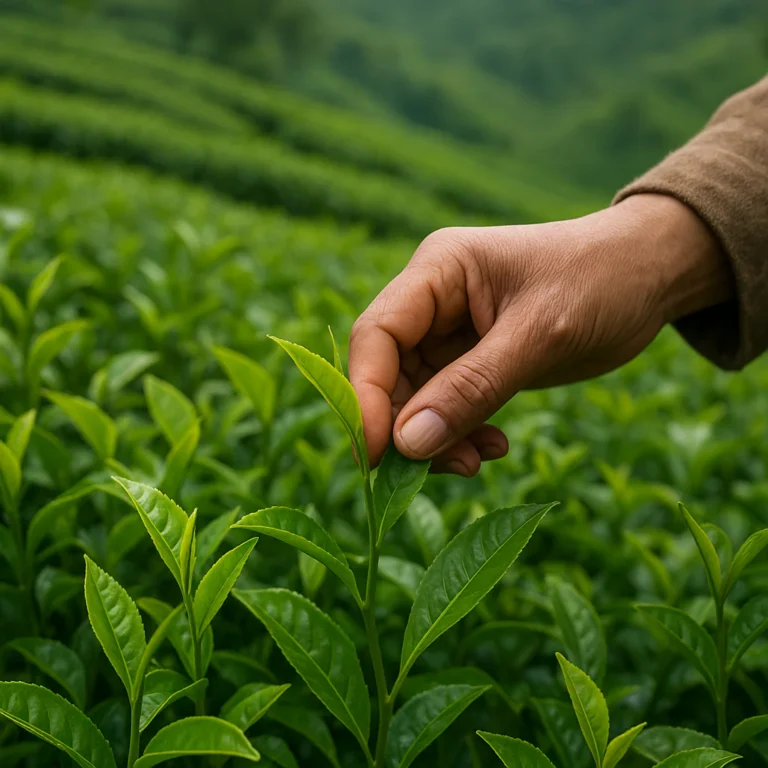
When to pick tea leaves for optimal quality? Harvest healthy, tender shoots when they reach your chosen plucking standard—often a bud with one or two young leaves—and pick after dew dries, before the day gets hot. The calendar can suggest when to start watching, but the shoots tell you when to pick.
At Growing Teas™, we’ve learned not to wait for every branch to look perfectly ready. During a fast-growing flush, the first shoots can turn coarse while later ones are still unfolding, so picking in careful passes helps keep the harvest tender and consistent.
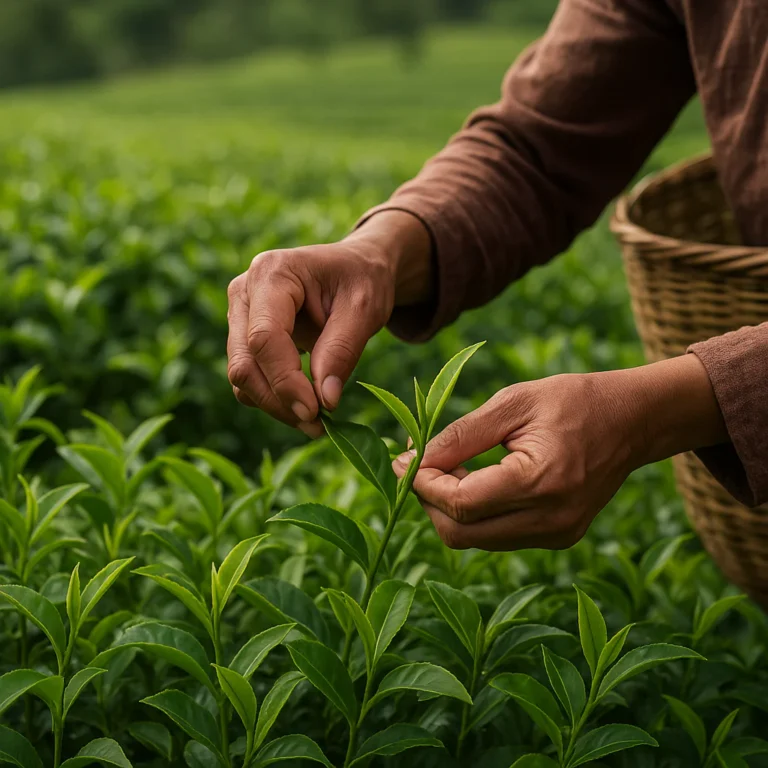
A common fine-plucking standard is one bud and two leaves, but the right choice depends on your tea style, local conditions, and whether you value delicate leaf selection or a larger harvest. Here’s how to spot the moment—and avoid letting the best shoots quietly grow past it.
Key Takeaways
- Pick by shoot maturity, not a fixed date. Inspect your tea bush regularly as new growth develops.
- For a quality-focused harvest, start with a bud and one or two young leaves. Adjust the standard to your tea style.
- Harvest dry leaves in mild conditions. A cool morning after dew dries is often convenient.
- Use selective plucking for greater uniformity; use shears when speed and volume matter more.
- Handle fresh leaves gently and process them promptly. Keep them shaded, airy, and out of hot, tightly packed containers.
Table of Contents
- ⚡ Quick Tips and Facts
- 🌱 Tea Harvest Background: Why Picking Time Shapes Quality
- 🍃 What “Optimal Quality” Means for Tea Leaves
- 🗓️ When to Pick Tea Leaves: The Best Time of Year
- First flush, second flush, and later harvests
- How climate, altitude, and tea variety affect the harvest window
- 🔎 How to Tell Tea Leaves Are Ready to Pick
- Bud-and-leaf standards: bud-only, one bud and one leaf, or finer plucking
- Leaf size, tenderness, color, and aroma cues
- When leaves are too young or too mature
- 🌤️ Best Time of Day to Harvest Tea
- ✂️ How to Pick Tea Leaves Without Damaging the Bush
- Hand plucking versus machine harvesting
- Harvesting tips for home-grown tea plants
- 🌦️ Weather and Field Conditions Before Plucking
- Picking after rain, dew, frost, or heat
- Why clean, dry leaves matter for tea processing
- 🍵 Picking Time by Tea Type and Processing Style
- Green tea harvest timing
- Black tea harvest timing
- White tea harvest timing
- Oolong tea harvest timing
- Pu-erh and other specialty tea harvests
- 🌿 How Harvest Timing Changes Flavor, Aroma, and Caffeine
- 🧺 What to Do Immediately After Picking
- Sorting, weighing, and handling fresh tea leaves
- How quickly to process newly harvested leaves
- ❌ Common Tea-Picking Mistakes and How to Avoid Them
- ❓ Frequently Asked Questions About Tea Harvesting
- Conclusion
- Recommended Links
- Reference Links
⚡️ Quick Tips and Facts
The best time to pick tea leaves is when the new shoots are healthy, tender, and developed to the plucking standard you want. In many quality-focused gardens, that means a bud with one or two young leaves—not a fixed calendar date. Climate, cultivar, elevation, rainfall, and the tea style all shift the window.
For a step-by-step guide to the whole harvest, see When and how should I harvest tea leaves?. Our practical rule at Growing Teas™ is simple: watch the shoots, not the calendar. 🌱
| Harvest decision | Quality-first guidance | Why it matters |
|---|---|---|
| Shoot maturity | Pick a tender bud and young leaves; a common standard is one bud and two leaves | Young shoots are generally tender and rich in flavor-related compounds |
| Picking interval | Recheck plants frequently; about 5–7 days can suit fast-growing conditions, but local growth determines the interval | Long gaps allow more shoots to become coarse |
| Season | Spring or another cool, slower-growth flush often favors character; warm, wet flushes may boost yield | Growth speed and weather influence leaf chemistry |
| Time of day | Harvest once dew has dried, preferably during a cool part of the day | Wet leaves can be harder to handle and may spoil faster |
| Technique | Selectively hand-pluck for premium leaf; shear only when speed and volume matter more | Selective picking gives you more control over shoot maturity |
| After picking | Keep leaves clean, shaded, and airy; process them promptly | Fresh leaves continue to change after harvest |
A review of tea-harvesting research describes fine plucking as commonly taking one bud and two leaves and reports that younger shoots generally contain more catechins and caffeine than mature leaves. It also finds that shorter plucking intervals often improve shoot fineness, though the best interval varies with the growing region and production system (tea-harvesting review). That variability is why we don’t treat “every seven days” as a universal law.
Quick checklist
- ✅ Choose healthy, actively growing shoots.
- ✅ Harvest when the leaves are dry and conditions are mild.
- ✅ Match the plucking standard to your tea style and quality goals.
- ❌ Don’t strip every leaf from a bush; leave enough foliage for healthy regrowth.
- ❌ Don’t let picked leaves sit in a hot, compressed heap.
If you’re growing tea at home, our Best Tea Picking Practices and Green Tea Cultivation guides can help you turn a healthy bush into a useful harvest. But first, what does “optimal quality” actually mean?
🌱 Tea Harvest Background: Why Picking Time Shapes Quality

Tea comes from the young shoots of Camellia sinensis. Once a shoot is picked, its age and condition help determine how it behaves during processing—and how the finished tea tastes. A tender shoot may suit delicate green or white tea; a more developed shoot can be appropriate for other styles or for gardens balancing quality with yield.
The harvest is only one part of the story. Cultivar, growing conditions, plucking standard, handling, and processing work together. A beautifully picked shoot can still make disappointing tea if it is bruised, overheated, or processed poorly.
| Factor | What it changes | Grower’s takeaway |
|---|---|---|
| Shoot age | Tenderness, texture, and leaf composition | Pick to a consistent maturity standard |
| Weather and growth rate | How quickly shoots emerge and mature | Inspect more often during rapid growth |
| Season | Flavor balance and harvest volume | Compare flushes rather than assuming one season always wins |
| Plucking method | Leaf uniformity and physical damage | Hand-pick when selectivity matters most |
| Post-harvest handling | Freshness and processing consistency | Keep the harvest shaded, airy, and moving |
The research review reports that teas from slower-growing shoots are often regarded as higher quality, while warm, wet periods can favor higher yields. That’s a useful general pattern, not a promise: local weather, variety, and processing can change the outcome (research review). A commercial grower may accept a broader picking standard to keep a factory supplied; a home grower making a small batch can afford to be chosier.
For broader cultivation advice, visit Growing Teas™’ Green Tea Cultivation and Fertilizers for Tea Plants. Good picking begins with a plant that is growing well—but “good growth” doesn’t mean letting every shoot get big.
🍃 What “Optimal Quality” Means for Tea Leaves
There is no single perfect plucking standard for every tea. For premium leaf, growers often favor uniform, tender shoots with a bud and young leaves. For a larger harvest, a coarser standard can increase the amount collected, but the leaf may be less uniform and more fibrous.
A review of tea-harvest research describes fine plucking as commonly taking a bud with two leaves, and coarse plucking as including additional, more mature leaves. The review also discusses a proposed blend of fine and coarse plucking to balance quality and productivity; that is a production strategy, not a universal recipe for every garden (review and cited studies).
| Harvest standard | What you pick | Likely advantage | Likely drawback |
|---|---|---|---|
| Bud only | Unopened or just-opening bud | Delicate, highly selective harvest | Very low volume; not suitable for every tea |
| Bud + one young leaf | Bud and first tender leaf | Fine, uniform material | Requires careful, slower plucking |
| Bud + two young leaves | Bud and two tender leaves | Useful quality-and-yield balance | Shots must be checked regularly to avoid overmaturity |
| Bud + three or more leaves | More developed shoot | Greater harvest volume and faster collection | More mature material can make the batch less uniform |
Quality is more than leaf size
A good harvest is made of leaves that are healthy, clean, and consistent. Avoid shoots that are diseased, insect-damaged, crushed, excessively woody, or contaminated with soil and debris. A tea’s final character also depends on processing: for example, black tea oxidation and green tea heat treatment create very different results from similar fresh material.
The review reports that younger shoots tend to contain more catechins and caffeine than older leaves, while more mature leaves generally have more fiber and lower levels of some quality-associated compounds. Those patterns help explain why tender plucking is prized, but they do not mean that one shoot standard guarantees a better cup (tea-harvesting review).
A quality-versus-yield snapshot
More selective plucking
Quality control ████
Harvest volume ██
Picking speed ██

Broader plucking
Quality control ████
Harvest volume ████
Picking speed ████
``

**Our recommendation:** if you’re making a small, high-quality batch, start with a bud and one or two young leaves. If you’re harvesting for volume, use a consistent broader standard rather than mixing tender tips with woody stems and old leaves at random.

## [🗓️ When to Pick Tea Leaves: The Best Time of Year](#️-when-to-pick-tea-leaves-the-best-time-of-year)

Tea bushes flush when conditions support new growth. In many tea-growing regions, the first flush follows seasonal dormancy or slower growth, with later flushes appearing as warmth and moisture increase. Exact dates vary widely by latitude, elevation, cultivar, and weather. **The plant’s shoot development is a more dependable guide than a date printed on a calendar.**

A seasonal study summarized in the tea-harvesting review found that some black-tea quality compounds were highest in early-season samples and lowest in rainy-season samples. Other cultivars showed different seasonal shifts, reinforcing the point that results from one region cannot simply be copied to another ([research review](https://pmc.ncbi.nlm.nih.gov/articles/PMC10743253/)).

| Growing conditions | Typical growth pattern | Potential quality–yield trade-off |
|---|---|---|
| **Cooler, drier conditions** | Slower shoot development | Often prized for character; harvest volume may be lower |
| **Warm, moist conditions** | Faster, more abundant growth | May increase volume; shoots can mature quickly |
| **Heavy rain or prolonged wetness** | Wet leaves and variable growth | Harvest and handling may be difficult; quality depends on local conditions |
| **Hot, dry stress** | Growth may slow or become irregular | Tender new growth can be limited; plant health takes priority |

### First flush, second flush, and later harvests

“Flush” refers to a period of new shoot growth, not a universal date. The first flush is often associated with spring harvests in seasonal climates; second and later flushes follow as growth resumes. Darjeling, for instance, is known for distinct flush periods, and tea styles from those periods can differ in aroma and taste. A tea guide describes the region’s first and second flushes as especially popular, but popularity is not the same as a single best harvest date ([tea selection guide](https://www.lifeisbetterwithtea.com/top-5-best-black-tea-selections/)).

Think of flushes as **different expressions of a garden**, not a beauty contest with one permanent winner. For your own bush, note when fresh shoots appear, how quickly they mature, and how each batch tastes after processing.

### How climate, altitude, and tea variety affect the harvest window

- **Altitude:** Cooler conditions at higher elevations can slow shoot growth, but local exposure and weather matter.
- **Cultivar:** Tea varieties differ in vigor, bud timing, and response to heat or moisture.
- **Rainfall:** Adequate moisture supports growth; persistent rain can complicate harvest and leaf handling.
- **Temperature:** Warmth can accelerate shoot development, shortening the time between inspections.
- **Garden management:** Pruning, soil health, shade, and plant age affect the flush.

The best record is a simple one: date, weather, shoot maturity, plucking standard, and how the finished tea tastes. After a few harvests, your notes become more useful than a generic regional calendar.

## [🔎 How to Tell Tea Leaves Are Ready to Pick](#-how-to-tell-tea-leaves-are-ready-to-pick)

Walk the bush and look for **fresh, healthy shoots at the maturity you want**. A ready shoot should be easy to distinguish from older, darker, tougher foliage. Don’t judge by leaf length alone: a small, tender leaf can be ready for a fine pluck, while a large leaf may already be too mature for that standard.

### Bud-and-leaf standards: bud-only, one bud and one leaf, or finer plucking

Before picking, choose one standard and stick to it. Consistency makes your harvest easier to process and compare.

1. **Inspect several branches.** Check whether new shoots are appearing evenly or in scattered patches.
2. **Choose your target.** For a selective harvest, look for a bud with one or two young leaves.
3. **Check the leaf texture.** Young leaves should feel tender, not leathery or woody.
4. **Separate ready shoots from late ones.** Leave immature buds to develop and overly mature shoots for plant growth or a later use.
5. **Keep the harvest consistent.** Avoid combining fine tips and mature leaves unless you intentionally want a broad-grade batch.

The research review reports that short picking intervals can help maintain finer shoots, while longer intervals increase the chance of coarse material entering the harvest. Its examples include comparisons of 5-, 7-, 9-, and 11-day rounds, but those findings come from specific production contexts, not a timetable that applies to every garden ([review](https://pmc.ncbi.nlm.nih.gov/articles/PMC10743253/)).

### Leaf size, tenderness, color, and aroma cues

| Cue | Ready-to-pick sign | Caution |
|---|---|---|
| **Bud** | Healthy, plump, and newly emerging | A tightly closed bud may not match every plucking standard |
| **Young leaves** | Soft and fresh, usually lighter than mature foliage | Color varies among cultivars |
| **Texture** | Tender and flexible | Avoid relying on a squeeze test that bruises the shoot |
| **Shoot health** | Clean, intact, and free of obvious disease or pest injury | Set damaged material aside |
| **Aroma** | Fresh, green, and clean when gently handled | Aroma varies by cultivar and weather |

No single color or size is a universal signal. The key is **maturity relative to your chosen standard**.

### When leaves are too young or too mature

**Too young:** a shoot may have an undeveloped bud or leaves that have not opened enough for your intended pluck. Taking it early can reduce the harvest without improving the finished tea.

**Too mature:** leaves become tougher as they develop, and the shoot may contain more stem or coarse leaf than a fine-grade batch needs. The research review associates mature material with higher fiber and lower levels of some compounds linked to tea quality ([review](https://pmc.ncbi.nlm.nih.gov/articles/PMC10743253/)).

Here’s the small-garden trap we see often: a grower waits for every shoot to look “big enough,” then discovers the first tips have already passed their best plucking stage. **Harvest in passes** when growth is uneven. That takes a little patience, but it avoids turning one tidy-looking basket into a mixed bag.

## [🌤️ Best Time of Day to Harvest Tea](#️-best-time-of-day-to-harvest-tea)

For most small gardens, pick **after dew has dried and before the day becomes hot**. This keeps the leaves drier and makes them easier to handle. If the morning is fogy or damp, wait. If the afternoon is scorching, wait for cooler conditions or harvest early the following day.

| Time or condition | Practical advice | Reason |
|---|---|---|
| **Early morning with dew** | Wait until leaves dry | Wet leaf is harder to manage cleanly |
| **Cool, dry morning** | Often a comfortable harvest window | Leaves are less exposed to midday heat |
| **Hot afternoon** | Avoid if possible | Heat can make fresh leaf handling more stressful |
| **After rainfall** | Wait until foliage dries and paths are safe | Reduces wet, muddy material in the basket |
| **Overcast, dry weather** | Often workable | Mild conditions can make selective picking comfortable |

There is no strong universal rule that morning tea leaves always make a better cup than afternoon leaves. **Dryness, temperature, shoot maturity, and prompt handling matter more than the clock alone.** For food-safety and post-harvest handling basics, follow clean harvesting practices such as those described by the [University of Minnesota Extension](https://extension.umn.edu/garden-and-home/yard-and-garden/gardening-in-minnesota/harvesting-and-storing-home-garden-vegetables), while remembering that tea processing has its own steps.

## [✂️ How to Pick Tea Leaves Without Damaging the Bush](#️-how-to-pick-tea-leaves-without-damaging-the-bush)

A good pluck removes the intended shoot without tearing up the branch or stripping the bush bare. **Selectivity protects both the quality of the batch and the future health of the plant.**

### Hand plucking versus machine harvesting

| Method | Best suited to | Strengths | Limitations |
|---|---|---|---|
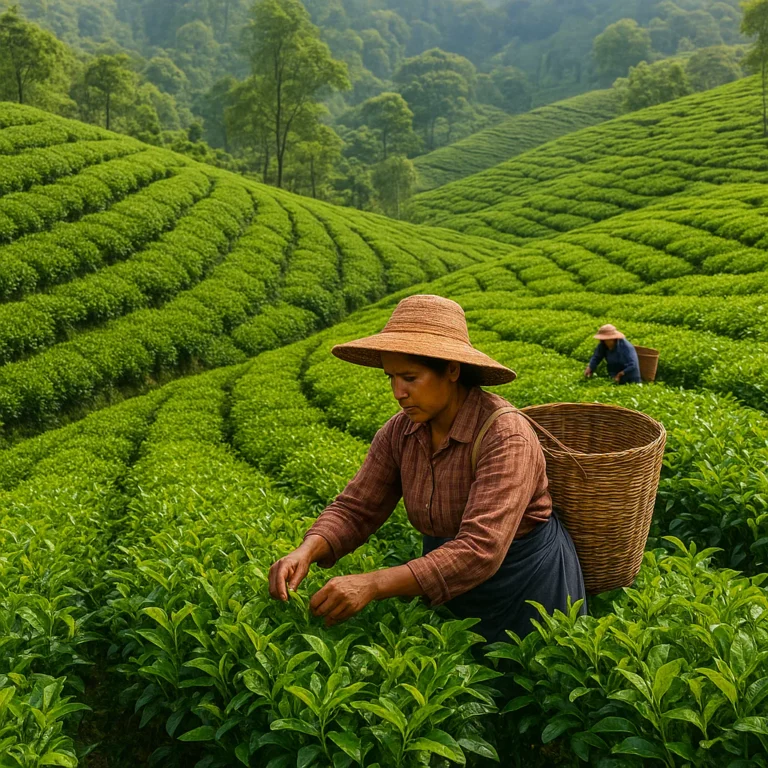
| **Selective hand plucking** | Small gardens and premium leaf | Picks to a chosen bud-and-leaf standard; allows damaged shoots to be skipped | Slower and more labor-intensive |
| **Hand shears** | Home gardens with a larger flush | Faster than individual plucking; easy to control around a shrub | Less selective; may cut mature and tender growth together |
| **Mechanical harvesting** | Large commercial operations | High speed and productivity | Can produce less uniform leaf and increase damage or coarse material |

The research review reports that hand-plucked samples scored better than shear-plucked samples in some comparisons, including differences in chemical measurements and professional tasting scores. Those are particular studies, not a guarantee that every hand-picked tea will outperform every machine-harvested tea. Machine harvesting has a practical place when volume and labor efficiency matter more than fine selection ([review and cited studies](https://pmc.ncbi.nlm.nih.gov/articles/PMC10743253/)).

For quality-focused home harvesting, use your fingertips to snap or pluck the tender shoot cleanly. Avoid pinching hard enough to crush the leaf. If you use scissors, keep them clean and sharp.

### Harvesting tips for home-grown tea plants

1. **Pick only from a healthy, established plant.** Don’t harvest heavily from a stressed or recently transplanted bush.
2. **Choose a dry day, if possible.** Wet foliage is more difficult to sort and handle.
3. **Work in small sections.** This helps you keep the plucking standard consistent.
4. **Leave plenty of healthy leaves and growing points.** The plant needs foliage to continue growing.
5. **Use a clean, shallow basket.** Don’t compress fresh shoots under a heavy pile.
6. **Separate damaged or diseased material.** Keep it out of your tea batch.
7. **Stop if the bush looks depleted.** A smaller harvest is better than weakening the plant.

If you’re tending a mixed edible garden, keep tea-plucking tools separate from tools used for compost, pesticides, or diseased plants. Our [Herbal Tea Planting](https://www.growingteas.com/category/herbal-tea-planting/) and [Fertilizers for Tea Plants](https://www.growingteas.com/category/fertilizers-for-tea-plants/) sections cover wider garden care.

## [🌦️ Weather and Field Conditions Before Plucking](#️-weather-and-field-conditions-before-plucking)

The ideal harvest begins before your fingers touch a shoot. Check the weather, inspect the bush, and make sure you have a clean place to keep the leaves. Rain can change both shoot growth and the condition of the harvest; heat can make newly picked foliage warm quickly.

### Picking after rain, dew, frost, or heat

- **After rain:** Wait until leaves are dry where possible. Don’t harvest from muddy or contaminated areas.
- **After dew:** Let moisture evaporate before plucking.
- **After frost:** Wait until the plant has thawed and assess the shoots for damage before harvesting.
- **During heat:** Pick during cooler hours, keep the basket shaded, and move the leaves promptly.
- **During strong wind:** Avoid harvesting leaves coated in dust or debris.

These are handling recommendations, not claims that weather alone determines cup quality. The tea-harvesting review describes seasonal differences in leaf chemistry and quality, but the effects depend on the cultivar, location, and processing method ([research review](https://pmc.ncbi.nlm.nih.gov/articles/PMC10743253/)).

### Why clean, dry leaves matter for tea processing

Fresh leaf is delicate. Wet, dirty, or compressed shoots are harder to sort and can heat up in a pile. Use a clean, ventilated container and keep the harvest out of direct sun while you finish picking. Don’t seal warm leaves in an airtight bag for a long wait.

**Field-ready checklist**
- ✅ Clean basket or tray
- ✅ Dry hands and clean tools
- ✅ Shade for temporary holding
- ✅ A plan for sorting and processing
- ❌ No sealed, tightly packed bags in hot conditions
- ❌ No leaves mixed with soil, weeds, or damaged material

## [🍵 Picking Time by Tea Type and Processing Style](#-picking-time-by-tea-type-and-processing-style)

The best plucking standard depends partly on what you plan to make. Tea type is created through processing, not simply by picking a different leaf, but tender shoots and consistent material make it easier to produce a controlled batch.

| Tea style | Common harvest approach | Grower’s note |
|---|---|---|
| **Green tea** | Tender shoots, often a bud with one or two leaves | Uniform fresh leaf helps with consistent heating |
| **Black tea** | Tender shoots; standards vary with grade and production | Young shoots provide material for oxidation and flavor development |
| **White tea** | Often selective buds or young shoots | Gentle handling matters; styles differ by region |
| **Oolong tea** | Mature enough for the intended rolling and oxidation style | Plucking standards vary widely by origin and maker |
| **Pu-erh and other specialty teas** | Depends on origin, cultivar, and processing tradition | Follow the product’s intended regional style rather than a generic rule |

### Green tea harvest timing

For green tea, growers commonly favor fresh, tender shoots and move them quickly into the planned heat-treatment process. Fine plucking can make a more uniform batch, while a broader harvest is more practical for larger volume. For garden planning and processing basics, see [Green Tea Cultivation](https://www.growingteas.com/category/green-tea-cultivation/).

### Black tea harvest timing

Black tea relies on withering, rolling, oxidation, and drying, so picking quality is only the first stage. The research review explains that young shoots supply compounds involved in black tea’s pigments and sensory properties; it also reports seasonal and plucking-standard effects that vary by context ([review](https://pmc.ncbi.nlm.nih.gov/articles/PMC10743253/)).

A consumer guide to black tea describes **Kemun Mao Feng** as a spring-harvest tea made from two leaves and a bud, and notes that Darjeling teas are associated with distinct flushes. These examples show how a region or named style can define a traditional harvest, but they shouldn’t be treated as universal rules for every black tea ([black tea guide](https://www.lifeisbetterwithtea.com/top-5-best-black-tea-selections/)).

### White tea harvest timing

White tea is often associated with young buds and leaves, but regional styles differ. Pick gently, sort carefully, and avoid pressing fresh leaf into a dense bundle. If you’re trying a small batch, record whether you used buds only, bud-plus-leaf, or a broader standard; that makes tasting comparisons useful.

### Oolong tea harvest timing

Oolong plucking standards vary by origin and production style. Some makers want shoots developed enough to withstand their rolling and oxidation steps. Don’t assume the finest or youngest possible pluck is automatically right for every olong.

### Pu-erh and other specialty tea harvests

Specialty teas follow specific traditions, cultivar choices, and processing practices. A broader leaf standard may be appropriate for some products, while premium hand-picked teas may emphasize selective shoots. Ask what the maker’s style requires—or, if processing your own leaves, test small batches before committing a whole harvest.

## [🌿 How Harvest Timing Changes Flavor, Aroma, and Caffeine](#-how-harvest-timing-changes-flavor-aroma-and-caffeine)

Shoot maturity and growing conditions affect the raw material that enters processing. Young and mature leaves differ in texture and composition, but **the finished flavor is shaped by the complete chain: plant, harvest, handling, and manufacture**.

| Harvest choice | Possible effect on the leaf | What you may notice in the finished tea |
|---|---|---|
| **Tender, fine pluck** | More uniform young material | Often sought for delicacy and aromatic character |
| **Mature, coarse pluck** | More developed, fibrous material | Can produce a less delicate or more astringent cup, depending on processing |
| **Cool, slow-growth flush** | Slower shoot development | May be associated with more concentrated character; yield can be lower |
| **Warm, wet flush** | Faster growth and greater volume in some settings | May yield more leaf, with different flavor and chemical balance |
| **Long gap between picks** | More overmature shoots in the basket | Less uniform raw material |

The research review summarizes evidence that younger tea shoots generally contain more catechins and caffeine than mature leaves, while other compounds shift with season and cultivar. It also discusses the role of catechins as precursors to black-tea pigments that contribute to color, briskness, and mouthfeel ([review](https://pmc.ncbi.nlm.nih.gov/articles/PMC10743253/)).

A note on caffeine: **don’t use leaf age as a precise caffeine calculator.** Caffeine content depends on many factors, including cultivar, leaf position, growing conditions, processing, and brewing. For general information on tea and health, see [Growing Teas™’ Health Benefits of Tea](https://www.growingteas.com/category/health-benefits-of-tea/) and the [USDA FoodData Central](https://fdc.nal.usda.gov/) database.

## [🧺 What to Do Immediately After Picking](#-what-to-do-imediately-after-picking)

Fresh leaves can lose quality if left warm, damp, or compressed. Sort and process them as soon as practical. The exact next step depends on the tea style: green tea is typically heated to limit oxidation, while black tea is intentionally oxidized after withering and rolling. Don’t leave a harvest waiting while you decide what to do with it.

### Sorting, weighing, and handling fresh tea leaves

1. **Spread the leaves in a clean, shallow layer.** This makes sorting easier and avoids compressing the shoots.
2. **Remove damaged material.** Set aside brown, diseased, insect-damaged, dirty, or woody pieces.
3. **Check consistency.** Separate fine tips from coarse shoots if you’re comparing grades.
4. **Weigh and label the batch.** Record cultivar, date, weather, plucking standard, and approximate quantity.
5. **Keep the leaves shaded and ventilated.** Avoid direct sunlight and sealed containers.
6. **Begin the intended processing promptly.** Follow a reliable method for the style you’re making.

### How quickly to process newly harvested leaves

There is no one exact “safe” holding time for every tea style and every set of conditions. A cool, dry harvest handled in a shallow basket is different from wet leaves packed tightly in a warm bag. **Use freshness and condition as your guide, and avoid unnecessary delays.**

For home growers, a small test batch is a smart teacher. Process one harvest promptly, then compare it with a batch held briefly under controlled, shaded, ventilated conditions. Keep everything else as similar as possible. Your tasting notes will tell you more than guesswork.

## [❌ Common Tea-Picking Mistakes and How to Avoid Them](#-common-tea-picking-mistakes-and-how-to-avoid-them)

| Mistake | Why it causes trouble | Better approach |
|---|---|---|
| **Picking by calendar alone** | Shots develop at different speeds with weather and cultivar | Inspect plant maturity directly |
| **Waiting until every shoot is large** | Early shoots can become coarse while you wait | Harvest in passes |
| **Mixing all leaf ages together** | Creates an inconsistent batch | Use one standard or sort by grade |
| **Plucking wet leaves** | Makes clean handling and processing harder | Wait for foliage to dry when practical |
| **Crushing shoots in the hand** | Bruising can make leaf handling less controlled | Use a light, clean pluck |
| **Overharvesting a young or stressed bush** | Can weaken the plant | Leave healthy foliage and growth points |
| **Leaving the harvest in a hot pile** | Encourages uneven warming and handling problems | Use a shallow, shaded, airy container |
| **Assuming one season is best everywhere** | Seasonal effects vary by place and cultivar | Compare flushes in your own garden |

The research review gives evidence that shorter intervals can improve shoot fineness in some settings, but it also notes that harvest strategies and yields vary by region and system. That’s why “pick every seven days” is best treated as a **starting point for inspection**, not a commandment carved into a tea chest ([review](https://pmc.ncbi.nlm.nih.gov/articles/PMC10743253/)).

## [❓ Frequently Asked Questions About Tea Harvesting](#-frequently-asked-questions-about-tea-harvesting)

### [What time of year is best for picking tea leaves?](#what-time-of-year-is-best-for-picking-tea-leaves)

The best season depends on your region, cultivar, and intended tea. In many seasonal tea-growing regions, **spring’s first flush** is prized for its distinctive character, while later flushes offer different flavors and often more growth. Research summarized in a review found higher levels of some black-tea quality compounds in early-season samples than in rainy-season samples, but other cultivars and regions can behave differently ([tea-harvesting review](https://pmc.ncbi.nlm.nih.gov/articles/PMC10743253/)).

For a home tea bush, harvest when healthy shoots reach your chosen maturity standard. Keep records across flushes and taste each batch before deciding which season you prefer.

### [Which tea leaves should you pick for the best flavor?](#which-tea-leaves-should-you-pick-for-the-best-flavor)

For a quality-focused general-purpose harvest, pick **healthy, tender shoots with one bud and one or two young leaves**. This is a useful starting point, not a strict rule for every tea. White, green, black, and olong styles can call for different standards and processing methods.

Skip leaves that are woody, diseased, crushed, or heavily damaged. The tea-harvesting review associates fine plucking with younger shoots and reports that mature leaves tend to be more fibrous and lower in some quality-associated compounds ([review](https://pmc.ncbi.nlm.nih.gov/articles/PMC10743253/)).

### [How often can you harvest leaves from a tea plant?](#how-often-can-you-harvest-leaves-from-a-tea-plant)

Harvest when new shoots are ready, not simply because a certain number of days has passed. In fast-growing conditions, inspect your bush every few days; research comparisons have included plucking rounds of 5, 7, 9, and 11 days, with shorter intervals producing finer shoots in some contexts. The right interval depends on temperature, rainfall, plant vigor, and labor availability ([review](https://pmc.ncbi.nlm.nih.gov/articles/PMC10743253/)).

Don’t harvest heavily if the plant is young, stressed, recently transplanted, or recovering from pruning. Leave healthy foliage so the bush can keep growing.

### [Should tea leaves be picked in the morning or afternoon?](#should-tea-leaves-be-picked-in-the-morning-or-afternoon)

Pick when the leaves are **dry and the weather is mild**. A cool morning after dew has evaporated is often convenient, but a dry, cool afternoon can also work. Avoid harvesting wet leaves or leaving fresh shoots in direct heat.

The clock matters less than shoot maturity and careful handling. If your morning is fogy, wait until the foliage dries; if the afternoon is hot, harvest earlier or defer until conditions improve.

### [Can you harvest tea leaves after rain?](#can-you-harvest-tea-leaves-after-rain)

Yes, once the leaves have dried and the garden is safe to work in. Wet leaves are harder to sort and handle, and muddy or splashed material should be kept out of the batch. After heavy rain, inspect shoots for damage before harvesting.

### [Can you pick tea leaves from a young tea plant?](#can-you-pick-tea-leaves-from-a-young-tea-plant)

A young plant may produce harvestable shoots, but **plant establishment comes first**. Heavy picking can slow a small or stressed bush. Let the plant build a healthy framework, and take only a light harvest if it is growing strongly. For cultivation support, see [Green Tea Cultivation](https://www.growingteas.com/category/green-tea-cultivation/).

### [Do tea leaves get more caffeine when they are picked young?](#do-tea-leaves-get-more-caffeine-when-they-are-picked-young)

Research summarized in the tea-harvesting review generally finds higher caffeine in younger shoots than in more mature leaves. However, caffeine also varies with cultivar, growing conditions, processing, and brewing. Leaf age alone cannot tell you exactly how much caffeine is in a cup ([review](https://pmc.ncbi.nlm.nih.gov/articles/PMC10743253/)).

### [Is hand-picked tea always better than machine-picked tea?](#is-hand-picked-tea-always-better-than-machine-picked-tea)

No. Hand picking offers more control over shoot maturity and can produce a more uniform batch, which is useful for premium tea. Machine harvesting is faster and more efficient for large-scale production. The review reports quality advantages for hand-plucked samples in some studies, but the outcome depends on equipment, harvest standard, processing, and the intended product ([review](https://pmc.ncbi.nlm.nih.gov/articles/PMC10743253/)).