Support our educational content for free when you purchase through links on our site. Learn more
🕵️ ♀️ 12 Tea Plant Diseases: The Ultimate Identification Guide (2026)

Have you ever stared at a leaf, wondering if that strange spot is a harmless blemish or the first sign of a fungal apocalypse? We certainly have. At Growing Teas™, we’ve watched more than one promising harvest turn into a lesson in humility when Blister Blight or Gray Blight struck without warning. Did you know that microbial diseases can wipe out up to 30% of a global tea crop annually? That’s enough tea to leave the world thirsty!
In this comprehensive guide, we’re ditching the dry academic jargon for a detective-style deep dive into the 12 most common tea plant diseases. From the fuzzy green invaders of Algal Leaf Spot to the silent, root-roting killers of Phytophthora, we’ll show you exactly how to spot the symptoms, differentiate them from nutrient deficiencies, and stop them in their tracks. We’ll even reveal how modern AI datasets and smartphone apps are revolutionizing how we diagnose these ailments, proving you don’t need a PhD to save your Camellia sinensis.
Key Takeaways
- Early Detection is Critical: Identifying symptoms like concentric rings, white blisters, or water-soaked patches before they spread can save your entire harvest.
- Know Your Enemy: We break down 12 distinct diseases, providing clear visual cues to distinguish between fungal, bacterial, algal, and viral infections.
- Prevention Over Cure: Implementing Integrated Pest Management (IPM), proper pruning, and soil drainage is far more effective than waiting for a chemical fix.
- Leverage Technology: Utilize modern datasets and AI tools to confirm your diagnosis with near-perfect accuracy.
- Organic Solutions Work: Discover proven natural remedies like neem oil and baking soda that protect your tea without harming the ecosystem.
Table of Contents
- ⚡️ Quick Tips and Facts
- 🌱 A Brief History of Tea Plant Pathology: From Ancient Blights to Modern Scourges
- 🔍 The Ultimate Guide to Identifying 12 Major Tea Plant Diseases
- 1. Algal Leaf Spot (Cephaleuros virescens): The Green Invader
- 2. Blister Blight (Exobasidium vexans): The Fungal Foe of Young Leaves
- 3. Gray Blight (Pestalotiopsis spp.): The Gray Ghost on Mature Foliage
- 4. Red Rust (Cephaleuros parasiticus): More Than Just a Red Herring
- 5. Root Rot (Phytophthora spp.): The Silent Killer Underground
- 6. Bacterial Blight (Pseudomonas syringae pv. theae): When Bacteria Strike
- 7. Dieback (Botryosphaeria dothidea): The Branch-By-Branch Decline
- 8. Leaf Spot (Coletotrichum spp.): The Spotted Scourge
- 9. Powdery Mildew (Erysiphe polygoni): The White Dusting
- 10. Anthracnose (Glomerella cingulata): The Darkening Dilemma
- 1. Mosaic Virus: The Mottled Mystery
- 12. Nematode Damage (Pratylenchus spp.): The Invisible Root Nuisance
- 🕵️ ♀️ Diagnostic Detective Work: How to Differentiate Diseases from Pests and Nutrient Deficiencies
- 🧪 Advanced Tea Disease Identification: Leveraging Datasets, AI, and Microscopy
- Understanding the Tea Sickness Dataset and Its Metadata
- How to Use Data Explorers for Camellia sinensis Analysis
- Activity Overview: Tracking Disease Outbreaks in Real-Time
- Collaborators, Authors, and Top Contributors in Tea Pathology Research
- DOI Citations, Provenance, and License Details for Research Data
- 🛡️ Integrated Pest Management (IPM): Strategies for Prevention and Control
- 🌿 Cultural Practices: Pruning, Shade, and Soil Health to Boost Immunity
- 💊 Chemical and Organic Treatments: What Actually Works?
- 📸 Visual Guide: High-Resolution Images for Accurate Disease Recognition
- ❓ Frequently Asked Questions About Tea Plant Diseases
- 🏁 Conclusion
- 🔗 Recommended Links
- 📚 Reference Links
⚡️ Quick Tips and Facts
Before we dive into the microscopic world of fungal spores and bacterial invasions, let’s get our hands dirty with the absolute essentials. At Growing Teas™, we’ve seen more tea bushes turn from lush green to sad brown than we’d like to admit, but we’ve also learned that early detection is the difference between a salvageable harvest and a total loss.
Here is the TL;DR for the busy tea gardener:
- The Golden Rule: If it looks weird, it probably is. Don’t ignore a single spotted leaf; it’s often the first domino in a chain reaction.
- The “Wet Finger” Test: If a spot rubs off with a wet finger, it’s likely Algal Leaf Spot or Red Rust. If it’s part of the leaf tissue, it’s fungal or bacterial.
- The 10% Rule: If more than 10% of your canopy shows symptoms, you need to act immediately. Waiting for “next season” is a recipe for disaster.
- Humidity is the Enemy: Most tea diseases (especially Blister Blight) thrive in high humidity and poor air circulation. If your tea garden feels like a sauna, you’re inviting trouble.
- Don’t Panic, Prune: Sometimes the best cure is a sharp pair of shears. Removing infected foliage can stop the spread faster than any spray.
Did you know? The global tea trade is valued at nearly $9.5 billion, yet annual crop losses from microbial diseases can range from 10% to 30% [IntechOpen]. That’s a lot of Earl Grey left on the shelf!
For those of you just starting your journey into the fascinating world of Cultivate Your Own Tea, remember that a healthy plant is a resilient plant. Check out our guide on Growing Teas to understand the foundational care your Camellia sinensis needs to fight off these invaders naturally.
🌱 A Brief History of Tea Plant Pathology: From Ancient Blights to Modern Scourges

Tea (Camellia sinensis) has been cultivated for thousands of years, originating in the misty mountains of Yunnan, China. But as soon as humans started planting tea in rows, nature started plotting against them.
The Ancient Struggle
Historical records from the 19th century in India and Sri Lanka (then Ceylon) describe the devastation of Blister Blight (Exobasidium vexans). Before the British established large-scale monocultures, tea grew in mixed forests where biodiversity kept pathogens in check. But when they cleared the land for endless rows of tea, they created a monoculture paradise for disease.
“The shift from forest-grown tea to monoculture plantations in the 180s inadvertently created the perfect storm for fungal epidemics,” notes historical agricultural studies.
The Evolution of Diagnosis
For centuries, diagnosis was purely symptomological. Farmers looked at the leaves and guessed. “Oh, it’s the gray spots again, must be the Pestalotiopsis.” But as we learned, Gray Blight and Brown Blight can look terrifyingly similar to the untrained eye.
It wasn’t until the 20th century that microscopy and culture methods allowed scientists to identify the specific fungi. Today, we are in the era of Molecular Diagnostics and AI, where we can detect a pathogen’s DNA before a single spot appears on a leaf.
🔍 The Ultimate Guide to Identifying 12 Major Tea Plant Diseases
Now, the moment you’ve been waiting for. How do you tell the difference between a Red Rust and a Red Scab? Or a Gray Blight and a nutrient deficiency? We’ve compiled the ultimate list of the 12 most common tea plant diseases, complete with symptoms, causes, and our expert “Grower’s Verdict.”
1. Algal Leaf Spot (Cephaleuros virescens)
The Green Invader
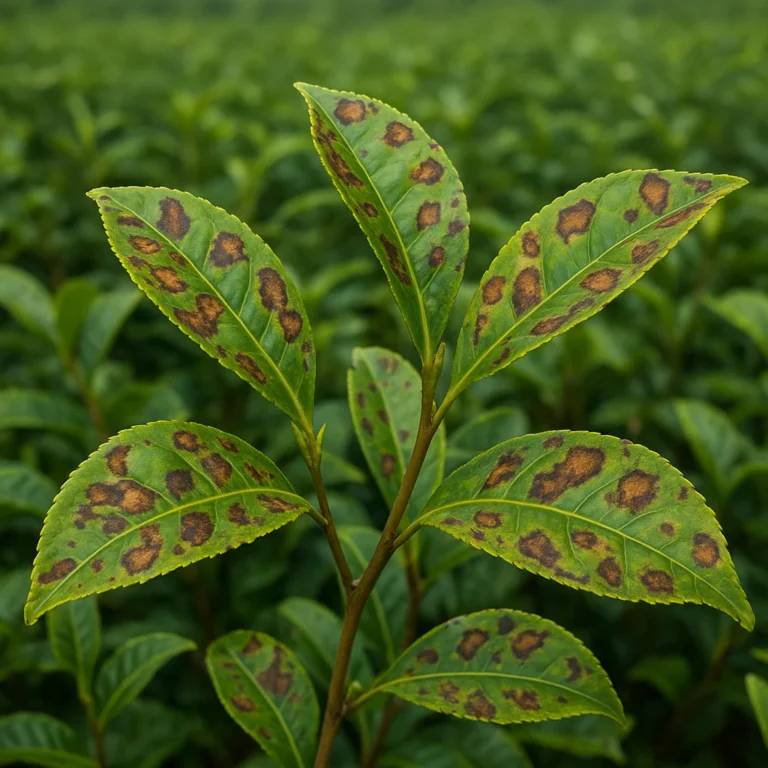
- Symptoms: Circular, raised, velvety spots that are greenish-gray to rusty red. They often have a distinct “halo.”
- The Tell-Tale Sign: If you scrape the spot, it feels fuzzy (it’s algae, not fungus!).
- Conditions: Thrives in high humidity and poor drainage.
- Impact: Reduces photosynthesis, leading to yellowing and premature leaf drop.
- Grower’s Tip: This is often a sign of over-fertilization with nitrogen.
2. Blister Blight (Exobasidium vexans)
The Fungal Foe of Young Leaves
- Symptoms: Pale yellow, translucent spots on the underside of young leaves. These spots turn into blisters with a white, powdery fungal growth (hymenium) on top.
- The Tell-Tale Sign: The white powder that rubs off easily.
- Conditions: Cool, wet weather (15–25°C) with high humidity.
- Impact: Can cause 20–50% crop loss if untreated. It targets the “two leaves and a bud” you want to harvest!
- Grower’s Tip: This is the #1 enemy of high-quality tea. Prune heavily and ensure good airflow.
3. Gray Blight (Pestalotiopsis spp.)
The Gray Ghost on Mature Foliage
- Symptoms: Small, brown spots that enlarge into grayish-white lesions with concentric rings. Black dots (acervuli) appear in the center.
- The Tell-Tale Sign: The concentric rings and the gray color on older, mature leaves.
- Conditions: Often follows physical damage or stress (drought, cold).
- Impact: Affects lower leaves first, reducing the plant’s energy reserves.
- Grower’s Tip: Unlike Blister Blight, this loves dry, hot weather followed by rain.
4. Red Rust (Cephaleuros parasiticus)
More Than Just a Red Herring
- Symptoms: Similar to Algal Leaf Spot but more intense red or rusty color. Can affect stems, making them rigid and cracked.
- The Tell-Tale Sign: The red color that penetrates the leaf tissue, not just the surface.
- Conditions: Warm, humid climates.
- Impact: Weakens the stem structure and reduces yield.
- Grower’s Tip: Often confused with Red Scab (a fungal disease). The key is the algal texture.
5. Root Rot (Phytophthora spp.)
The Silent Killer Underground
- Symptoms: Wilting of the entire bush, yellowing leaves, and stunted growth. The roots turn brown/black and mushy.
- The Tell-Tale Sign: Pull up a plant. If the roots are soft and smelly, it’s root rot.
- Conditions: Waterlogged soil is the primary culprit.
- Impact: Fatal if not caught early. The plant dies from the roots up.
- Grower’s Tip: Drainage is your best friend here. Don’t plant in heavy clay without amendment.
6. Bacterial Blight (Pseudomonas syringae pv. theae)
When Bacteria Strike
- Symptoms: Water-soaked spots on young leaves that merge into large, necrotic patches. Leaves turn black and die.
- The Tell-Tale Sign: The water-soaked appearance and rapid spread in cool, wet conditions.
- Conditions: Cool temperatures (10–20°C) with high humidity.
- Impact: Can kill young shoots rapidly.
- Grower’s Tip: Copper-based sprays can help, but prevention via sanitation is key.
7. Dieback (Botryosphaeria dothidea)
The Branch-By-Branch Decline
- Symptoms: Oval, sunken, dark lesions on stems and branches. Leaves above the lesion turn yellow and die.
- The Tell-Tale Sign: The cankers on the wody stems.
- Conditions: Stress from drought, cold, or mechanical damage.
- Impact: Progressive death of branches, reducing the bush’s size.
- Grower’s Tip: Prune out infected branches well below the lesion.
8. Leaf Spot (Coletotrichum spp.)
The Spotted Scourge
- Symptoms: Brown to black spots with concentric rings. Often surrounded by a yellow halo.
- The Tell-Tale Sign: The concentric rings (target-like appearance).
- Conditions: Warm, humid weather.
- Impact: Reduces leaf quality and yield.
- Grower’s Tip: Often confused with Gray Blight. The brown color is the giveaway.
9. Powdery Mildew (Erysiphe polygoni)
The White Dusting
- Symptoms: White, powdery growth on the surface of leaves and stems.
- The Tell-Tale Sign: The powdery texture that wipes off easily.
- Conditions: Moderate temperatures with high humidity but dry leaf surfaces.
- Impact: Stunts growth and reduces photosynthesis.
- Grower’s Tip: Unlike other fungi, this doesn’t need free water to germinate.
10. Anthracnose (Glomerella cingulata)
The Darkening Dilemma
- Symptoms: Dark brown to black lesions that can cover large areas of the leaf.
- The Tell-Tale Sign: The dark, necrotic appearance and the presence of acervuli (black dots).
- Conditions: Warm, wet weather.
- Impact: Severe defoliation.
- Grower’s Tip: Often a secondary infection following other stresses.
1. Mosaic Virus
The Mottled Mystery
- Symptoms: Mottled or mosaic patterns of light and dark green on leaves. Leaves may be distorted or stunted.
- The Tell-Tale Sign: The iregular color patterns that don’t look like spots.
- Conditions: Spread by aphids and other insects.
- Impact: Weakens the plant and reduces yield.
- Grower’s Tip: Control the insect vectors! There is no cure for the virus itself.
12. Nematode Damage (Pratylenchus spp.)
The Invisible Root Nuisance
- Symptoms: Stunted growth, yellowing, and root galls or lesions.
- The Tell-Tale Sign: You can’t see them with the naked eye. You need a microscope or a soil test.
- Conditions: Sandy soils are more susceptible.
- Impact: Reduces root function, leading to nutrient deficiencies.
- Grower’s Tip: Rotate crops and use nematode-resistant varieties if possible.
| Disease | Primary Pathogen | Key Symptom | Ideal Conditions | Severity |
|---|---|---|---|---|
| Blister Blight | Exobasidium vexans | White blisters on young leaves | Cool, Wet | ⭐ |
| Gray Blight | Pestalotiopsis spp. | Gray spots with rings on old leaves | Dry, Hot | ⭐ |
| Algal Leaf Spot | Cephaleuros virescens | Green/Red velvety spots | Humid | ⭐ |
| Root Rot | Phytophthora spp. | Mushy, brown roots | Waterlogged | ⭐ |
| Bacterial Blight | Pseudomonas | Water-soaked spots | Cool, Wet | ⭐ |
🕵️ ♀️ Diagnostic Detective Work: How to Differentiate Diseases from Pests and Nutrient Deficiencies
So, you see a yellow spot. Is it Blister Blight? Is it Nitrogen deficiency? Or did a spider mite get to it? This is where the real detective work begins.
The “Symptom vs. Sign” Rule
As Dr. Cheryl Smith from the UNH Cooperative Extension explains in our featured video Diagnosing Plant Problems, you must distinguish between:
- Symptoms: The plant’s reaction (e.g., yellowing, wilting).
- Signs: The actual pathogen (e.g., fungal spores, insect bodies).
“If you see a white powder, that’s a sign. If you see a yellow leaf, that’s a symptom. The yellow leaf could be anything!”
The Differentiation Matrix
| Feature | Fungal Disease | Bacterial Disease | Nutrient Deficiency | Pest Damage |
|---|---|---|---|---|
| Pattern | Often localized spots, concentric rings | Water-soaked, irregular patches | Uniform yellowing (chlorosis) | Iregular holes, webing, stipling |
| Speed | Moderate to fast | Very fast (rapid spread) | Slow (seasonal) | Fast (if infestation is high) |
| Location | Often starts on older leaves or young shoots | Young shoots, water-soaked | Older leaves (mobile nutrients) or new leaves (immobile) | Anywhere, often underside |
| Smell | Earthy, musty | Foul, rotten | None | None |
| Microscope | Spores, hyphae | Bacteria streaming from cut | None | Insects, eggs |
The “Landscape Factor”
Don’t forget the environment!
- Low/Wet Areas: Likely Root Rot or Bacterial Blight.
- Wind Exposure: Likely Dieback or physical damage leading to secondary infections.
- Uniform Symptoms: Likely Abiotic (environmental) or Nutrient issues.
- Scattered Symptoms: Likely Biotic (disease or pest).
🧪 Advanced Tea Disease Identification: Leveraging Datasets, AI, and Microscopy
Gone are the days of guessing. We are now in the age of Deep Learning and Molecular Diagnostics. Let’s peek behind the curtain of modern tea pathology.
Understanding the Tea Sickness Dataset and Its Metadata
One of the most exciting resources for researchers and tech-savy growers is the Tea Sickness Dataset (available on Kagle and Mendeley).
- Overview: This dataset contains 2,134 images of tea leaves, categorized into 8 classes (7 diseases + 1 healthy).
- Diseases Covered: Red leaf spot, Algal leaf spot, Bird’s eyespot, Gray blight, White spot, Anthracnose, Brown blight.
- Source: Colected from Johnstone Boiyon farm in Kenya.
- Usability: Rated 6.9/10 for usability, but it’s a goldmine for training Machine Learning models.
“This tea sickness dataset contains tea leaves showing 7 common diseases of tea,” says the dataset author. “It can be used with transfer learning for Machine learning models for predicting sickness in tea.”
How to Use Data Explorers for Camellia sinensis Analysis
Platforms like Kagle and Mendeley Data allow you to explore these datasets. You can:
- Visualize the distribution of diseases.
- Train your own AI model to identify diseases from photos.
- Compare your local symptoms with the dataset images.
Activity Overview: Tracking Disease Outbreaks in Real-Time
Imagine a world where your smartphone app tells you, “Hey, you have Blister Blight in sector 4!” This is becoming a reality.
- TeaDiseaseNet: A recent study introduced a multi-scale self-attention model that achieved 95.3% precision in detecting tea diseases, even with complex backgrounds.
- Smartphone Apps: Apps using YOLOv8 and ResNet50 are being developed for on-site diagnosis by farmers.
Collaborators, Authors, and Top Contributors in Tea Pathology Research
The field is driven by global collaboration.
- Key Institutions: Anhui Agricultural University (China), Tea Research Institute (India), and various universities in Kenya and Sri Lanka.
- Notable Researchers: Dr. Jiang Zhaohui (TeaDiseaseNet), Shashwat Tiwari (Dataset Creator).
DOI Citations, Provenance, and License Details for Research Data
For the academic-minded, the Tea Sickness Dataset is available under a specific license (check the Mendeley Data page for details). Always cite the DOI (10.17632/j32xdt2ff5.2) when using this data in your research.
🛡️ Integrated Pest Management (IPM): Strategies for Prevention and Control
Prevention is better than cure, especially in tea. Integrated Pest Management (IPM) combines cultural, biological, and chemical methods to keep diseases at bay.
Cultural Controls
- Pruning: Regular pruning improves air circulation and removes infected tissue.
- Shade Management: Too much shade increases humidity (bad for Blister Blight), but too little causes stress. Find the balance.
- Sanitation: Remove and destroy fallen leaves. They are a breeding ground for spores.
Biological Controls
- Beneficial Microbes: Use Trichoderma species to combat root rot.
- Predatory Insects: Encourage ladybugs and lacewings to control aphids (vectors for viruses).
Chemical Controls (Use with Caution)
- Fungicides: Copper-based sprays for Bacterial Blight and Fungal diseases.
- Timing: Apply preventatively before the rainy season.
- Rotation: Rotate fungicides to prevent resistance.
🌿 Cultural Practices: Pruning, Shade, and Soil Health to Boost Immunity
A healthy plant is a resistant plant. Here’s how to build a fortress around your tea bushes.
Pruning Techniques
- Light Pruning: Removes the top 1-2 inches of growth to stimulate new, disease-free shoots.
- Heavy Pruning: Removes infected branches and rejuvenates the bush.
- Timing: Prune during the dry season to minimize spread.
Shade Management
- Optimal Shade: 30-40% shade is ideal for most tea varieties.
- Tree Selection: Use nitrogen-fixing trees like Albizia or Grevillea to improve soil health.
Soil Health
- pH Balance: Tea prefers acidic soil (pH 4.5–5.5).
- Organic Matter: Add compost to improve drainage and microbial diversity.
- Mulching: Use organic mulch to retain moisture and suppress weeds.
💊 Chemical and Organic Treatments: What Actually Works?
When prevention fails, what do you do? Let’s look at the options.
Organic Treatments
- Nem Oil: Effective against Powdery Mildew and some fungal diseases.
- Baking Soda Solution: A classic remedy for Powdery Mildew. Mix 1 tsp baking soda, 1/2 tsp liquid soap, and 1 quart of water.
- Copper Fungicides: Effective against Bacterial Blight and Fungal diseases, but use sparingly to avoid soil toxicity.
Chemical Treatments
- Systemic Fungicides: Absorbed by the plant and protect from the inside out.
- Contact Fungicides: Kill spores on contact.
- Antibiotics: Rarely used in tea, but copper-based bactericides are common.
Warning: Always follow label instructions. Overuse of chemicals can lead to resistance and harm beneficial insects.
📸 Visual Guide: High-Resolution Images for Accurate Disease Recognition
Since we can’t show you images here, we recommend using the Tea Sickness Dataset on Kagle or the TeaDiseaseNet project to view high-resolution images of each disease.
- Key Visual Cues: Look for concentric rings, white powder, water-soaked spots, and root discoloration.
- Comparison: Compare your leaves with the dataset images to confirm your diagnosis.
❓ Frequently Asked Questions About Tea Plant Diseases
What preventive measures can I take to protect my tea plants from diseases?
Prune regularly to improve airflow, remove fallen leaves, and maintain proper soil pH. Avoid over-fertilization and ensure good drainage.
How does climate affect the prevalence of tea plant diseases?
High humidity and cool temperatures favor Blister Blight and Bacterial Blight. Hot, dry weather followed by rain favors Gray Blight. Waterlogged soil leads to Root Rot.
What natural remedies can help control tea plant diseases?
Nem oil, baking soda solutions, and copper fungicides (used sparingly) are effective organic options. Beneficial microbes like Trichoderma can also help.
How do I differentiate between nutrient deficiency and disease in tea plants?
Nutrient deficiencies usually cause uniform yellowing or stunted growth across the whole plant. Diseases often present as localized spots, rings, or specific patterns on leaves.
What are the symptoms of fungal infections in tea plants?
Spots (brown, gray, red), rings, white powder, blisters, and necrotic lesions.
How can I identify tea plant diseases early?
Regular inspection of leaves (top and bottom), monitoring weather conditions, and using AI tools or smartphone apps for early detection.
What are the common diseases that affect tea plants?
Blister Blight, Gray Blight, Algal Leaf Spot, Root Rot, Bacterial Blight, and Dieback.
How do I identify common tea plant diseases?
By observing symptoms (spots, rings, powder) and signs (spores, bacteria) and comparing them with reference images or datasets.
What are the early signs of tea plant blight?
Pale yellow spots on young leaves (Blister Blight) or water-soaked patches (Bacterial Blight).
Can I treat tea plant fungus with organic methods?
Yes, nem oil, baking soda, and copper fungicides can be effective. Pruning and improving airflow are also crucial.
Why are my tea leaves turning yellow and spotted?
This could be Algal Leaf Spot, Gray Blight, or a nutrient deficiency. Check for rings or powder to differentiate.
What causes root rot in tea plants?
Waterlogged soil and por drainage are the primary causes.
How can I prevent fungal infections in my tea garden?
Prune for airflow, remove infected leaves, and avoid overhead watering.
Are there natural pesticides for tea plant diseases?
Nem oil and beneficial microbes are effective natural options.
🏁 Conclusion

Identifying tea plant diseases is a mix of art, science, and detective work. From the ancient struggles of the 19th-century plantations to the AI-driven diagnostics of today, the fight against disease is ongoing.
Key Takeaways:
- Early detection is crucial.
- Differentiate between symptoms and signs.
- Use technology (datasets, AI) to aid your diagnosis.
- Prevention through cultural practices is the best defense.
We hope this guide has empowered you to become a tea plant detective. Remember, a healthy tea bush is a happy tea bush, and a happy tea bush makes the best cup of tea!
🔗 Recommended Links
👉 Shop for Tea Plant Care Products:
- Pruning Shears: Amazon | Walmart | Fiskars Official
- Organic Fungicides: Amazon | Walmart | Bonide Official
- Soil Test Kits: Amazon | Walmart | Luster Leaf Official
Books on Tea Plant Diseases:
- Tea Plant Diseases and Their Management on Amazon.
📚 Reference Links
- Disease Diagnosis in Tea (Camellia sinensis (L.) Kuntze) – IntechOpen
- TeaSickness Dataset – Kagle
- TeaDiseaseNet: Multi-Scale Self-Attentive Tea Disease Detection – Frontiers in Plant Science
- UNH Cooperative Extension: Diagnosing Plant Problems
- Growing Teas: Green Tea Cultivation
- Growing Teas: Organic Farming Techniques