Support our educational content for free when you purchase through links on our site. Learn more
Tea Plant Fungus Treatment and Prevention: 9 Steps 🍃

Tea plant fungus treatment and prevention starts with accurate diagnosis, clean pruning, and better growing conditions—not a mystery spray. Remove heavily affected leaves, clear fallen debris, improve airflow and drainage, and use fungicides only when the product label specifically allows the treatment on tea or the applicable edible crop.
At Growing Teas™, we’ve seen how tempting it is to blame every brown spot on fungus. But a tea plant with spotted leaves may also be reacting to sogy roots, pests, cold, or sudden sun exposure. The clue that changed our approach? Damaged leaves rarely recover, so we track new growth to tell whether our care is working.
Key Takeaways
- Diagnose before treating: Leaf spots and wilting can have fungal, pest-related, or environmental causes.
- Start with practical prevention: Remove badly affected tissue, collect fallen leaves, water at the roots, and improve airflow and drainage.
- Don’t expect old damage to disappear: Judge recovery by the health of new leaves and shoots.
- Treat tea as an edible crop: Use a fungicide only when its label permits the crop and intended use; follow harvest restrictions.
- Get help if symptoms spread: A local extension service or plant-diagnostic lab can help identify persistent or severe problems.
Table of Contents
- ⚡️ Quick Tips and Facts
- 🌱 Tea Plant Fungal Diseases: Background and Basics
- What counts as a tea plant—and what counts as fungus?
- How fungal diseases spread through tea gardens
- 🔍 How to Identify Fungus on Tea Plants
- Leaf spots, blights, and unusual patches
- White powder, fuzzy growth, and soty coatings
- Root rot, stem cankers, and dieback
- Fungal disease or pest, nutrient, or weather damage?
- When to seek a laboratory diagnosis
- 🍃 Common Tea Plant Fungal Diseases and Their Symptoms
- Anthracnose and leaf blight
- Grey blight and brown blight
- Leaf spot and algal leaf spot lookalikes
- Root rot and seedling damping-off
- Stem canker and branch dieback
- Powdery mildew and soty mold
- 🧰 Tea Plant Fungus Treatment: 9 Practical Steps
- 1. Confirm the likely cause before treating
- 2. Isolate affected potted tea plants
- 3. Remove infected leaves and branches
- 4. Dispose of diseased debris safely
- 5. Correct watering and improve drainage
- 6. Improve airflow and light
- 7. Choose an appropriate fungicide, if needed
- 8. Apply treatments safely and at the right time
- 9. Monitor new growth and reassess
- 🧪 Fungicides and Home Remedies: What Works—and What Doesn’t
- Copper-based fungicides and other labeled products
- Neem oil, baking soda, and homemade sprays
- Why fungicides may not cure existing damage
- Protecting tea leaves intended for harvest
- 🛡️ Preventing Fungal Disease in Tea Plants
- Choose healthy plants and disease-free planting material
- Plant in suitable soil and growing conditions
- Water at the roots and avoid prolonged leaf wetness
- Prune for airflow and sanitize tools
- Manage mulch, weeds, and fallen leaves
- Inspect plants and use quarantine wisely
- 🌦️ Seasonal Tea Plant Care and Disease Prevention
- Rainy, humid, and monsoon conditions
- Cool weather, frost, and winter protection
- Warm, dry weather and container-grown tea
- 🪴 Caring for Tea Plants in Pots and Indors
- Poting mix, drainage holes, and repoting
- Humidity, ventilation, and grow lights
- Cleaning containers and preventing reinfection
- 🍵 Fungal Disease in Tea Gardens and Harvests
- How leaf disease affects growth and yield
- Harvest hygiene and postharvest handling
- Organic and integrated pest management approaches
- ❓ Tea Plant Fungus Treatment FAQs
- Can a tea plant recover from fungal disease?
- Should I remove every spotted leaf?
- Can I use fungicide on tea leaves I plan to drink?
- How often should I inspect my tea plant?
- Why does fungus keep returning?
- ✅ Conclusion
- 🔗 Recommended Links
- 📚 Reference Links
⚡️ Quick Tips and Facts
For a broader overview of tea-plant problems, see our guide to common pests and diseases that affect tea plants. At Growing Teas™, we’ve learned that the best fungal treatment often starts with a pair of clean pruning shears—not a spray bottle.
| Quick fact | What it means for your tea plant |
|---|---|
| Old lesions don’t heal | Remove badly affected leaves; judge recovery by whether new growth stays healthy. |
| Wet foliage encourages many leaf diseases | Water the soil rather than repeatedly weting the canopy, and give leaves time to dry. |
| “Fungus” symptoms aren’t always fungal | Water stress, pests, nutrient problems, and sun or cold injury can look similar. Diagnose before treating. |
| Drainage matters | Persistently saturated poting mix can damage roots and favor root diseases. |
| Fungicide labels determine safe use | Use a product only if its label permits your plant, disease, application site, and intended harvest use. |
| Tea leaves are food | Don’t assume a garden fungicide is suitable for leaves you plan to brew. Observe label restrictions and preharvest intervals. |
Our quick response plan:
- ✅ Photograph symptoms and inspect both sides of leaves, stems, and the soil surface.
- ✅ Remove severely diseased tissue with clean tools; collect fallen leaves.
- ✅ Correct watering, drainage, spacing, or ventilation problems.
- ✅ Ask a local extension service or plant-diagnostic lab for help if symptoms keep spreading.
- ❌ Don’t spray a mystery mixture on tea leaves you intend to drink.
- ❌ Don’t compost heavily diseased material unless your local guidance confirms the composting process will destroy the pathogen.
The University of Minnesota Extension recommends careful diagnosis because different problems can produce similar symptoms. That’s especially useful with tea: a brown patch is a clue, not a conviction. 🍃
🌱 Tea Plant Fungal Diseases: Background and Basics

Tea is Camellia sinensis, an evergreen shrub grown for its leaves. Like other plants, it can be affected by fungal and fungus-like organisms, but the right response depends on the particular problem, local climate, and growing conditions. Advice for roses or houseplants can offer general sanitation principles, but it doesn’t automatically transfer to tea crops.
What counts as a tea plant—and what counts as fungus?
In this guide, “tea plant” means Camellia sinensis, not herbal tea plants such as mint or chamomile. The distinction matters: different plants have different pathogens, and edible-leaf use adds an extra layer of care.
A fungal disease is caused by a fungus; some plant diseases are caused by fungus-like organisms, such as oomycetes. Symptoms alone usually can’t identify the exact organism. For diagnosis, use a plant clinic or extension service rather than trying to name a pathogen from one photo. The University of California Statewide Integrated Pest Management Program offers practical guidance on integrated pest management and diagnosing garden problems.
If you’re growing tea at home, our green tea cultivation resources can help with the growing conditions that support vigorous plants. For other brewing plants, see herbal tea planting.
How fungal diseases spread through tea gardens
Depending on the pathogen, spores or other infectious material may move in wind, splashing water, contaminated tools, infected plant material, or soil. Many leaf diseases become more troublesome when foliage stays wet for extended periods. Wounds from pruning, weather, or pests can also provide entry points for some pathogens.
That does not mean every fungal disease needs dry air. Tea plants need appropriate moisture to grow, and conditions that suppress one disease can stress the plant or encourage another problem. Aim for good airflow, suitable soil moisture, and leaves that can dry between wet periods, rather than trying to make your tea garden desert-dry.
🔍 How to Identify Fungus on Tea Plants
Start with the pattern, not the product. Note which leaves are affected, how quickly symptoms are advancing, whether the plant is in a pot or the ground, and what changed recently: rain, watering, repoting, pruning, a new plant nearby, or a cold snap.
| What you see | Possible explanations | First useful check |
|---|---|---|
| Brown or tan leaf spots | Fungal or bacterial leaf disease, sun scorch, cold injury, chemical damage | Look for halos, lesion patterns, and whether spots are spreading |
| Yellow leaves and leaf drop | Wet roots, drought, nutrient issues, normal aging, disease | Check soil moisture and root-zone drainage |
| White coating | Powdery mildew, mineral residue, spray deposits, or other surface growth | See whether it rubs off and whether new leaves are distorted |
| Black, sticky-looking film | Sooty mold growing on honeydew from insects | Inspect stems and leaf undersides for scale insects or aphids |
| Wilting despite wet soil | Root damage, poor drainage, root disease | Check for sour odor, soft roots, and standing water |
| One branch dying back | Wound, cold damage, canker, root stress, or other disease | Inspect the branch base and pruning or weather history |
Leaf spots, blights, and unusual patches
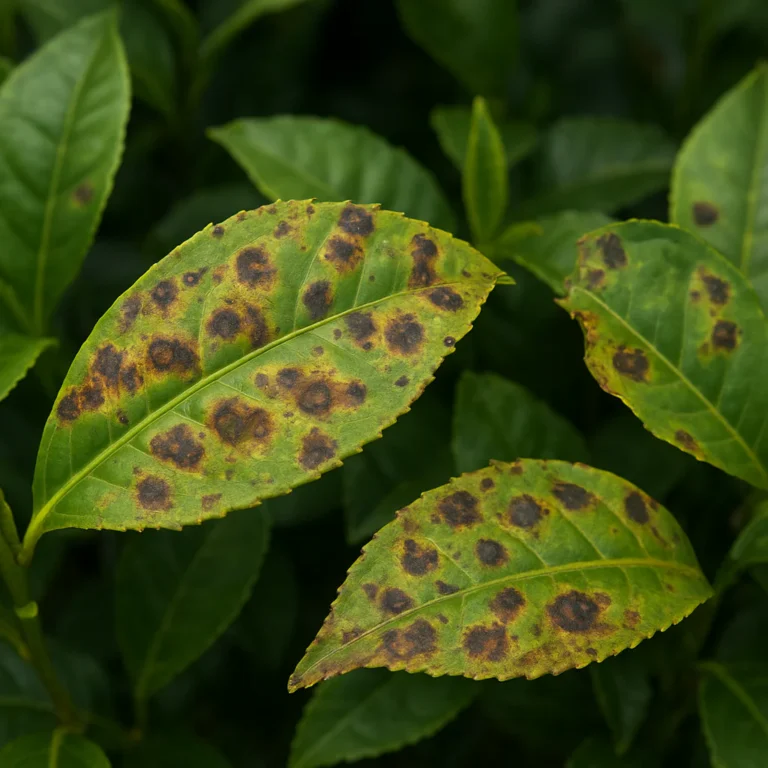
Fungal leaf spots may appear as tan, brown, reddish, or dark lesions. Some develop yellow margins or rings; others merge into larger blighted areas. A pattern spreading across several leaves after prolonged wet weather raises suspicion, but it still isn’t a laboratory diagnosis.
Look at the age and location of affected leaves. Damage on the sun-facing side after a heat wave may suggest scorch. A few older leaves yellowing near the base may be normal aging. Spots that continue appearing on new growth deserve closer attention.
White powder, fuzzy growth, and soty coatings
Powdery growth can be associated with mildew, while fuzzy gray growth may occur on dead or decaying plant tissue under humid conditions. A black coating is often soty mold, which typically grows on sugary honeydew produced by sap-feding insects; controlling the insects is central to managing the coating. The Royal Horticultural Society explains the relationship between soty mold and honeydew-producing pests.
Don’t rub a suspicious coating and assume the problem is solved. Check whether it returns, whether it is on living or dead tissue, and whether insects are present.
Root rot, stem cankers, and dieback
Root trouble often shows above ground as yellowing, wilting, weak growth, or sudden decline. Gently inspect a small area of the root ball if the plant is potted: healthy roots are generally firm, while dead or rotting roots may be dark, soft, or unpleasant-smelling. Root symptoms can result from waterlogging, physical damage, or disease, so don’t assume a fungicide is the answer.
A canker-like lesion or dying branch also has multiple possible causes. Note whether damage begins at a pruning cut, frost injury, or broken stem. Remove clearly dead material with sanitized tools, but seek a diagnosis if the damage is moving into healthy stems or the plant’s base.
Fungal disease or pest, nutrient, or weather damage?
Before treating, check the alternatives:
- Pests: inspect leaf undersides, stems, and new growth for scale, mites, aphids, webing, or honeydew.
- Water stress: compare soil moisture below the surface; a dry crust doesn’t prove the root ball is dry, and wet poting mix doesn’t guarantee healthy roots.
- Nutrient issues: review recent feeding and growing conditions before adding fertilizer. Extra fertilizer won’t cure an infection and can worsen stress.
- Weather injury: consider frost, heat, wind, and abrupt shifts in sun exposure.
- Chemical injury: check whether symptoms began after a spray, cleaning product, or accidental drift.
Our video reference demonstrates this sensible first step on a different houseplant: rule out watering, light, and pest problems before deciding the cause is fungal. Its example is Dieffenbachia, not tea, so use the diagnostic principle—not its treatment directions as a tea-plant prescription.
When to seek a laboratory diagnosis
Contact a local university extension office, plant clinic, or diagnostic lab when:
- Symptoms spread despite correcting growing conditions.
- Several tea plants are affected at once.
- The plant is valuable, newly imported, or part of a commercial planting.
- Roots or stems are declining without a clear cause.
- You need to know whether a product is appropriate for an edible-leaf crop.
Send clear photos of the whole plant and close-ups of both sides of affected leaves. Keep a sample fresh and follow the lab’s packaging instructions; a sogy bag of decomposing leaves is a plant pathologist’s least favorite mystery novel.
🍃 Common Tea Plant Fungal Diseases and Their Symptoms
The names below describe general disease categories reported on plants, not a claim that every tea plant with these symptoms has that disease. Tea pathogens vary by region, and a definitive identification may require lab testing. For regional agricultural advice, consult your local extension or tea-growing authority.
| Symptom group | Typical clues | What to do first |
|---|---|---|
| Anthracnose-like lesions | Dark, sunken or irregular spots; lesions may expand in wet conditions | Remove badly affected tissue, reduce splash, and seek diagnosis if spreading |
| Blight or leaf spot | Brown patches, sometimes with defined edges or yellowing | Collect fallen leaves and improve airflow |
| Root decline | Wilting, yellowing, weak growth with persistently wet soil | Address drainage and inspect roots |
| Stem canker or dieback | Localized dead area, cracked bark, or branch decline | Prune dead material cleanly and investigate the cause |
| Powdery or fuzzy growth | Surface growth, often more noticeable on sheltered tissue | Check the plant and microclimate; confirm the diagnosis |
Anthracnose and leaf blight
“Anthracnose” is a broad disease label used for symptoms associated with several fungal groups. Leaf lesions can be dark, irregular, or sunken; severe infections may cause blighting or leaf loss. Similar symptoms can result from other diseases or environmental injury.
Remove severely damaged leaves, avoid overhead watering when practical, and keep the canopy open enough for airflow. If new lesions continue appearing, get a diagnosis rather than repeatedly applying a broad-spectrum product.
Grey blight and brown blight
Blight names generally describe the appearance of damaged foliage, not one universal pathogen or treatment. Gray, brown, or expanding dead areas may appear on leaves, especially where wet conditions and dense growth persist. Tea-growing regions may use particular disease names for locally important problems, so regional extension guidance is especially valuable.
Avoid carrying infected leaves through the planting, and clean tools between affected plants. A product labeled for rose blight is not automatically labeled for tea blight.
Leaf spot and algal leaf spot lookalikes
Leaf spots can have fungal, bacterial, algal, or noninfectious causes. A raised, orange-red or greenish patch, for example, may not be the same problem as a flat brown lesion. Treatment based only on color can miss the actual cause.
Photograph the pattern over several days. If lesions appear on new leaves or spread after wet weather, share the photos with an extension specialist. Remove fallen diseased leaves and reduce water splash while you investigate.
Root rot and seedling damping-off
Damping-off can affect seedlings in overly wet, poorly ventilated propagation conditions. Young stems may collapse near the soil line; affected seedlings often cannot be rescued. Discard them and their contaminated growing medium, clean trays, and restart with fresh, well-draining medium and clean containers.
For established tea plants, root decline is not automatically infectious. Sogy soil and blocked drainage can cause serious root damage on their own. The Royal Horticultural Society’s guide to root rot explains why drainage and growing conditions matter.
Stem canker and branch dieback
Cankers may look like sunken, cracked, or discolored areas on stems, with growth declining beyond the lesion. Injury from pruning, frost, wind, or pests may complicate diagnosis. Remove dead branches during suitable weather, cutting into healthy tissue with a clean tool. If cankers appear on multiple stems or approach the crown, seek local advice before extensive pruning.
Powdery mildew and soty mold
Powdery mildew and soty mold are easy to confuse when all you notice is a pale or dark film. Powdery mildew is a disease of plant tissue; soty mold is commonly associated with insect honeydew. Inspect for insects before reaching for fungicide. If you find scale or aphids, manage those pests using locally appropriate methods and follow their product labels.
🧰 Tea Plant Fungus Treatment: 9 Practical Steps
A useful treatment plan is a sequence, not a magic spray. We use this order because it fixes common underlying problems and avoids unnecessary chemical exposure.
1. Confirm the likely cause before treating
Record:
- When symptoms first appeared.
- Whether the affected leaves are old or new.
- Recent rain, watering, pruning, cold, heat, repoting, or fertilizer use.
- Whether other plants nearby have similar symptoms.
- Whether pests, sticky residue, or webing are present.
Compare photos over time. If the cause remains unclear, consult an extension service or diagnostic lab. Treating the wrong problem wastes time and may injure the plant.
2. Isolate affected potted tea plants
If one potted plant has suspicious symptoms, move it away from other tea plants while you inspect it. Avoid placing it where wind or watering can carry plant debris onto healthy leaves. Keep the plant’s light and temperature reasonably stable; isolation shouldn’t become a sudden trip into a dark, stuffy corner.
3. Remove infected leaves and branches
Prune tissue that is dead or heavily affected, especially if it is dropping onto healthy growth. Use sharp tools and make clean cuts. Don’t strip a plant bare: tea needs healthy foliage to photosynthesize and recover.
A houseplant video linked in the featured-video section emphasizes removing contaminated leaves rather than expecting damaged tissue to heal. That’s sound general garden hygiene, but its copper-spray advice is not a tea-specific label recommendation.
4. Dispose of diseased debris safely
Bag and discard heavily diseased material according to local waste guidance. Clean up fallen leaves under and around the plant. Don’t leave infected clippings in a damp pile beside the tea shrub; that’s less “natural recycling” and more “pathogen staycation.”
Clean tools after working on a diseased plant. The University of Minnesota Extension provides guidance on cleaning gardening tools. Follow the product or disinfectant label and avoid mixing household chemicals.
5. Correct watering and improve drainage
Check the soil before watering. Water thoroughly when needed, then allow excess water to drain freely. For containers, confirm that drainage holes are open and that the pot is not sitting in a saucer full of water.
If the mix stays saturated, investigate compacted medium, a pot that is too large, blocked holes, or frequent watering. Don’t try to cure root problems by keeping the plant completely dry; stressed tea plants can struggle too.
6. Improve airflow and light
Give foliage space, remove weeds or clutter that trap humidity, and avoid crowding plants against walls or each other. Provide suitable light for Camellia sinensis and acclimate plants gradually if you move them into brighter conditions. Suden strong sun can scorch foliage and make diagnosis more confusing.
The first-video example calls dry air a strong preventive measure, but we’d phrase the tea-growing lesson more carefully: avoid persistently damp, stagnant conditions without depriving the plant of the moisture it needs.
7. Choose an appropriate fungicide, if needed
Consider a fungicide only when you have a plausible fungal diagnosis, cultural improvements are in place, and the product label allows use on tea or the relevant edible crop. A fungicide may protect healthy tissue or suppress certain pathogens; it usually cannot restore a leaf that is already dead.
Before buying, verify:
- The crop and use site are included on the label.
- The disease is listed or the product is appropriate under local guidance.
- The product is permitted where you live.
- Harvest intervals and re-entry directions are clear.
- The formulation won’t injure tea foliage under your conditions.
8. Apply treatments safely and at the right time
Read the entire label before opening the container. Follow the stated concentration, coverage, protective equipment, weather restrictions, reapplication interval, and harvest interval. Don’t increase the dose because symptoms look dramatic.
Test a small area when the label allows and watch for plant injury. Avoid spraying during heat, drought stress, strong wind, or conditions that could expose people, pets, pollinators, or nearby water. Never apply a rose-labeled fungicide to tea unless its label explicitly allows that use.
9. Monitor new growth and reassess
Mark or photograph affected areas and check the plant regularly. Look for new lesions, healthy leaves, renewed growth, or changes in wilting. A plant may retain old scars even after the underlying issue is controlled, so new growth is a better progress report than old leaves.
If symptoms continue despite sanitation and care corrections, stop guessing. Send photos and a symptom history to a local plant clinic.
🧪 Fungicides and Home Remedies: What Works—and What Doesn’t
The word “natural” doesn’t automatically mean safe, effective, or approved for edible tea leaves. Likewise, a familiar commercial product isn’t automatically suitable for Camellia sinensis. Product names and registrations vary by country and change over time.
| Option | Potential role | Main cautions |
|---|---|---|
| Copper fungicide | May be labeled for certain plant diseases and crops | Tea use must appear on the label; overuse can injure plants and contribute to copper accumulation in soil |
| Sulfur product | Used for some labeled plant diseases | Can injure plants in heat and may conflict with oil applications; check label timing |
| Neem-based product | Some formulations are labeled for particular pests or diseases | Formulations differ; check crop, target, temperature limits, pollinator precautions, and harvest interval |
| Baking soda mixtures | May suppress some surface diseases in certain contexts | Home recipes can burn foliage and are not a substitute for a labeled crop treatment |
| Green tea extract | Laboratory research has examined antimicrobial activity | Not established as a tea-plant fungicide or field treatment |
Copper-based fungicides and other labeled products
Copper products are used against some plant diseases, but effectiveness and permitted crops depend on the active ingredient and label. A product sold under a brand such as Bonide Captain Jack’s or Monterey Lawn & Garden still needs to be checked product by product. Brand familiarity does not replace label directions.
Copper can cause plant injury under unsuitable conditions, and repeated use may build up copper in soil. The National Pesticide Information Center explains copper’s uses and safety considerations. Use only a product whose current label permits your crop and intended use.
Neem oil, baking soda, and homemade sprays
Neem products vary in their formulation and intended target. Some are sold as insecticides, some have disease-related claims, and labels differ. Don’t assume all neem oils are interchangeable. The U.S. Environmental Protection Agency’s pesticide product and label resources help explain why the label is the controlling document.
Baking-soda recipes found online may alter leaf-surface conditions, but homemade mixes can burn leaves, especially in heat or when combined with oils. A spray being easy to mix in a kitchen does not make it proven or safe for harvested tea. Test cautiously only where appropriate, and don’t use a homemade treatment on harvestable leaves without reliable crop-specific guidance.
Why fungicides may not cure existing damage
Many fungicides are protectants: they help prevent infection on treated tissue but do not repair dead cells. Some products have different activity, but whether they can suppress an established disease depends on the active ingredient, pathogen, timing, and label.
This is why sanitation and environmental correction matter. Remove what is badly damaged, protect healthy growth only with an appropriate labeled product, and address the condition that allowed the disease to thrive.
Protecting tea leaves intended for harvest
Tea is an edible crop. Before any pesticide application, confirm that tea or the applicable food crop is on the label and follow the preharvest interval, application limits, and all other directions. If the label does not clearly permit the use, don’t apply it to leaves you plan to brew.
The U.S. Environmental Protection Agency explains that pesticide labels are legally binding directions. When in doubt, contact your local agricultural extension service or pesticide regulator.
🛡️ Preventing Fungal Disease in Tea Plants
Prevention is mostly about avoiding the conditions that make disease easier to establish while keeping the tea plant healthy. That means clean planting material, sensible watering, airflow, and routine observation—not spraying on a calendar without a reason.
Choose healthy plants and disease-free planting material
Inspect new plants before bringing them near established tea. Check leaf undersides, stems, pot rims, and the growing medium for spots, insects, webing, or mold. Quarantine new container plants when possible and avoid propagating from diseased stock.
Plant in suitable soil and growing conditions
Choose a site and soil that suit tea in your climate. Avoid poorly drained spots where water stands after rain. For container plants, use a suitable, well-draining medium and a pot with unobstructed drainage. Adjust conditions gradually; sudden changes in exposure or moisture can stress leaves and complicate disease diagnosis.
If you’re reviewing a feeding routine, see our resources on fertilizers for tea plants. Fertilizer supports growth when used appropriately, but it is not a fungicide.
Water at the roots and avoid prolonged leaf wetness
Water near the soil instead of repeatedly spraying foliage. Where overhead watering is unavoidable, do it early enough for leaves to dry. Avoid frequent light watering that keeps the soil surface and lower leaves damp without fully moistening the root zone.
Prune for airflow and sanitize tools
Remove dead, crossing, or badly diseased branches when appropriate, but avoid aggressive pruning that weakens the shrub. Clean tools between affected plants, especially if cutting suspicious tissue. Keep the canopy open enough for air to move without exposing previously shaded leaves to abrupt, intense sun.
Manage mulch, weeds, and fallen leaves
Remove fallen diseased foliage and keep weeds from crowding the plant. Mulch can help conserve soil moisture, but keep it from piling against stems and follow local recommendations for the crop and climate. Don’t use a thick, wet blanket of debris to “protect” a tea shrub; that can trap moisture around the base.
Our organic farming techniques section covers broader soil and garden practices. Organic methods still need to be evidence-based and safe for the crop.
Inspect plants and use quarantine wisely
Make a quick inspection part of your routine, especially after long wet spells or when new growth appears. Look for fresh lesions, insect activity, droping tips, and standing water. Catching a problem early often means removing a few leaves and correcting care rather than facing a full shrub in distress.
🌦️ Seasonal Tea Plant Care and Disease Prevention
Season changes alter both plant stress and disease risk. Use these as flexible prompts, not a rigid spray schedule.
Rainy, humid, and monsoon conditions
After repeated rain, inspect dense growth and check whether water drains away from the root zone. Clear fallen leaves and avoid pruning when foliage is wet if you can wait for a dry window. Don’t respond to every wet week with fungicide; first confirm the likely disease and permitted control.
Cool weather, frost, and winter protection
Cold or frost injury can create brown leaves that resemble infection. Protect tea plants according to local hardiness and container conditions, and avoid pruning frost-damaged growth until you can distinguish dead tissue from living stems. Remove clearly diseased debris, but don’t make drastic cuts based on a single post-frost inspection.
Warm, dry weather and container-grown tea
Heat and drought can stress tea, while some products can injure foliage in hot weather. Check container moisture more often, but don’t leave pots sitting in water. Before applying any oil, sulfur, or other product, follow its label’s temperature and plant-stress precautions.
🪴 Caring for Tea Plants in Pots and Indors
Tea can be grown in containers, but indoor conditions often mean slower air movement and less natural leaf drying. The answer is not simply to make indoor air as dry as possible: tea still needs appropriate moisture and suitable light.
Poting mix, drainage holes, and repoting
Use a container with drainage holes and a medium that drains freely while retaining enough moisture for the plant. If water runs down the sides without weting the root ball, or the medium stays sogy for days, reassess the mix and watering routine. Repot when needed with clean equipment rather than reusing contaminated medium.
Humidity, ventilation, and grow lights
Provide gentle air movement without blasting the plant with a drying fan. Give the plant enough light for healthy growth and avoid sudden moves from shade to strong direct sun. Remove dead leaves promptly; indoor leaf litter can stay damp and be easy to overlook.
Cleaning containers and preventing reinfection
Wash pots, trays, and tools after a diseased plant is removed. Discard suspect poting medium rather than recycling it around healthy tea plants. Keep saucers clean and empty standing water.
🍵 Fungal Disease in Tea Gardens and Harvests
A home-grown tea shrub and a commercial tea garden share the same broad principles—diagnosis, sanitation, healthy growing conditions, and careful product selection—but scale changes the stakes. In a garden, a few affected leaves may be manageable. In a production field, disease can affect yield, labor, and harvest quality.
How leaf disease affects growth and yield
Severe leaf loss reduces the plant’s ability to photosynthesize and may weaken future growth. For a small plant, recovery can be slow after extensive defoliation. For a larger planting, track the extent and spread of symptoms rather than treating a few isolated marks as a crisis.
Harvest hygiene and postharvest handling
Keep harvested leaves separate from visibly diseased material and use clean harvest containers. Follow local food-safety requirements for washing, handling, and processing. If pesticide use is involved, obey the label’s harvest interval and any residue requirements.
Organic and integrated pest management approaches
Integrated pest management combines monitoring, cultural controls, biological approaches where suitable, and pesticides only when justified. Organic production also has rules: an “organic” claim or natural active ingredient doesn’t automatically establish safety, legality, or efficacy on tea. For U.S. organic operations, consult the USDA National Organic Program and a certifier before using a product.
❓ Tea Plant Fungus Treatment FAQs

How do you treat fungal diseases on tea plants naturally?
Begin with nonchemical steps: confirm that symptoms are plausibly fungal, remove severely affected tissue, collect fallen leaves, improve airflow, and correct watering or drainage. These measures reduce disease pressure without leaving residues on leaves.
“Natural” sprays are not automatically effective or safe. Neem, copper, sulfur, and homemade baking-soda mixtures all require careful attention to the formulation, crop label, weather restrictions, and harvest use. For leaves you plan to drink, don’t use an unverified homemade spray.
Read more about “12 Organic Pest Control Methods for Tea Plants 🌿”
What fungicides are safe to use on tea plants?
There is no universally safe answer by brand or active ingredient. Use only a product whose current label permits application to tea or the applicable edible crop and target disease in your location. Follow its harvest interval and all precautions.
If tea is not named on the label, contact your agricultural extension service or pesticide regulator before use. A product recommended for roses, ornamentals, or houseplants may not be lawful or suitable for tea leaves.
Read more about “7 Common Tea Plant Diseases and How to Control Them 🌿”
How can you prevent root rot and leaf spot on tea plants?
For root problems, use freely draining soil or poting medium, keep drainage holes open, and water according to actual soil moisture. For leaf spots, remove fallen infected material, avoid prolonged leaf wetness, and allow airflow around the canopy. If symptoms recur, identify the cause: a cultural problem, pathogen, or pest requires a different response.
What are the signs of fungal infection in tea plants?
Possible signs include spreading brown, tan, or dark leaf lesions; yellowing around spots; blighted patches; powdery or fuzzy growth; and branch dieback. Root disease may show as wilting or yellowing when the soil is wet. None of these signs alone proves a fungal infection, so check for pests, watering problems, and weather injury too.
Read more about “🌱 How Often to Inspect Tea Plants for Pests?”
Can a tea plant recover from fungal disease?
Often, yes—especially if the damage is limited and the underlying cause is corrected. Existing dead or spotted tissue generally won’t turn green again, so watch the new growth. Severe root, stem, or crown damage may be harder to reverse; seek a diagnosis if decline continues.
Read more about “15 Common Tea Plant Pests & Diseases—and How to Prevent Them 🫖 (2026)”
Should I remove every spotted leaf?
No. Remove leaves that are badly diseased, dying, or likely to drop, but keep healthy foliage so the plant can continue making energy. If spotting is extensive, avoid stripping the shrub bare; diagnose the problem and prune selectively.
Can I use fungicide on tea leaves I plan to drink?
Only if the product label explicitly permits the use and you follow all directions, including the preharvest interval. If the label is unclear or excludes tea, don’t apply it to harvestable foliage. When in doubt, contact a local extension specialist or pesticide authority.
Read more about “🐞 12 Ways to Stop Tea Garden Pests”
Why does fungus keep returning?
The original cause may still be present: infected debris, wet foliage, poor drainage, crowding, contaminated tools, or an incorrect diagnosis. Some plant diseases also recur when weather favors infection. Review growing conditions and symptoms again before repeating a spray; repeated treatment without diagnosis can miss the real problem.
Does green tea extract treat fungus on tea plants?
No reliable tea-crop treatment recommendation follows from laboratory research on green tea compounds. A review of catechins reports antifungal findings involving organisms such as Candida and Aspergillus, describing results as “very promising data,” but it does not test fungal disease control on Camellia sinensis or provide a field-use protocol. See the review in Molecules. Lab antimicrobial activity is interesting science—not a recipe for spraying your tea shrub.
Read more about “11 Common Tea Plant Diseases and Organic Fixes 🍃”
Do recommendations for rose diseases apply to tea plants?
Only broad gardening principles, such as sanitation and avoiding prolonged leaf wetness, may be useful as general guidance. The Clemson guide covers roses, not tea, and its disease lists and fungicide suggestions should not be treated as tea-crop directions. Always check crop-specific labels and local advice.
Read more about “Can IPM Protect Tea Plants? 10 Smart Tactics 🌱”